
Garden greenhouse kits range from compact shelving enclosures to permanent cedar growing rooms, so the right choice depends on space, weather exposure, and how much assembly and upkeep I am willing to accept. I rank the EverBloom 6.5’x10′ Wooden Greenhouse as Best Overall because its irrigation, ventilation, and practical footprint create the strongest balance for serious home growing. The Greengro Walk-in Greenhouse is my Best Value pick for buyers who want accessible plant storage without committing to a permanent structure, while the Backyard Discovery Bellerose XL is the premium choice for maximum space and integrated utilities. The main tradeoffs are portability versus durability, shelf capacity versus open growing space, and low initial complexity versus better climate control. Continue reading for my full breakdown of which model fits each type of gardener.

Get garden gear delivered free with Prime
- Fast, free delivery on millions of items
- Prime Video, Amazon Music and more included
- Member-only deals all year
Key Takeaways
- EverBloom offers the best overall balance: it combines more growing room and built-in water and airflow features without reaching the Bellerose XL’s much larger footprint.
- Greengro provides the strongest value proposition for a buyer who wants walk-in access in a slim 28-by-57-inch format, though it offers less working room than the wooden models.
- The 56x55x74-inch three-tier model is the easiest starting point for organized seedling production, but eight shelves favor trays and small pots over tall crops.
- Backyard Discovery’s Bellerose XL is the clear premium pick because cedar construction, polycarbonate panels, power access, ventilation, and hose hookups make it closer to a garden room than a portable enclosure.
- VEVOR and the 6×4-foot hygrometer model solve different space problems: VEVOR suits a long, narrow site, while the 6×4-foot kit gives climate-conscious growers a larger open footprint and basic humidity monitoring.


| garden greenhouse kit | Dimensions | Frame Material | Cover Material |
|---|---|---|---|
| 56x55x74 Inch Greenhouse for O | 56 x 55 x 74 inches | Galvanized steel | Polyethylene |
| Greengro Greenhouse | 28 x 57 x 76 inches | — | High-tensile polyethylene |
| VEVOR Walk-in Greenhouse | 76.8 x 30.3 x 66.1 inches | Powder-coated steel | 140 gsm polyethylene |
| EverBloom 6.5’x10′ Wooden Gree | 6.5 x 10 feet | — | — |
| Backyard Discovery Bellerose X | 13 x 11 feet | — | — |
| 6x4FT Greenhouse with Hygromet | — | Aluminum alloy | — |
More Details on Our Top Picks
56x55x74 Inch Greenhouse for Outdoors, 3 Tier 8 Shelves White
I place the 56x55x74 Inch Greenhouse high for gardeners who need organized growing space without committing to a permanent structure. Its eight shelves separate seed trays, herbs, and supplies more effectively than the narrower Greengro Greenhouse, while the 74-inch height leaves room to step inside and tend plants. The galvanized frame and UV-resistant PE cover make it better prepared for outdoor exposure than a basic indoor grow rack. Still, its 27.5-pound portable build is a mixed blessing: relocation is manageable, but exposed yards may demand heavier anchors. Instructions may also slow the otherwise tool-free setup. Compared with the VEVOR Walk-in Greenhouse, this model favors shelf capacity over adjustable ventilation, since no dedicated windows are listed.
Pros:- Eight shelves provide substantial separation for trays, pots, and supplies
- Galvanized steel frame resists rust during outdoor use
- UV-resistant PE cover helps protect plants and the enclosure
- Tool-free assembly takes about 30 minutes
Cons:- Lightweight frame may require extra anchoring in strong winds
- Lacks the dedicated ventilation windows found on the VEVOR model
- Assembly instructions may be difficult to follow
Best for: Seed starters and herb growers who want eight organized shelves in a medium-size patio or backyard greenhouse
Not ideal for: Gardeners in exposed, high-wind locations who cannot add anchors or place the greenhouse near shelter
- Dimensions:56 x 55 x 74 inches
- Shelf Count:8
- Weight:27.5 pounds
- Frame Material:Galvanized steel
- Cover Material:Polyethylene
- UV Resistance:Yes
- Assembly Method:Tool-free
- Estimated Assembly Time:Approximately 30 minutes
Our verdict“I recommend this kit for gardeners who value abundant shelving more than advanced ventilation or heavy-weather performance.”
Greengro Greenhouse, 28 x 57 x 76 inches Walk-in Greenhouse for Outdoors and Indoor Use
I see the Greengro Greenhouse as the practical choice for balconies, slim patios, and indoor utility spaces where width matters. Its 28-inch-wide footprint is roughly half the width of the 56x55x74 Inch Greenhouse, yet its 76-inch height still provides walk-in access. A 22-pound capacity per shelf supports seed trays and smaller pots, while the high-tensile polyethylene cover shields plants from rain, pests, and temperature swings. The stated 45 mph wind resistance gives it an advantage over portable kits without a published rating, though I would not treat that figure as permission to leave it exposed during severe storms. The tradeoff for the narrow shape is limited room for broad foliage and large containers. Its indoor-or-outdoor flexibility remains the main reason it earns a place here.
Pros:- Slim 28-inch width fits spaces that cannot accommodate wider walk-in kits
- 76-inch height permits standing access
- Each shelf supports up to 22 pounds
- Published wind resistance reaches 45 mph
Cons:- Narrow interior restricts large plants and wide containers
- Setup requires careful attention to the instructions
- Portable construction is not intended for extreme weather
Best for: Apartment gardeners and seed starters who need a tall walk-in enclosure for a narrow balcony, patio, garage, or utility room
Not ideal for: Growers raising large tomato plants, shrubs, or broad container collections that need more floor area
- Dimensions:28 x 57 x 76 inches
- Cover Material:High-tensile polyethylene
- Frame Diameter:16 mm
- Shelf Capacity:22 pounds per shelf
- Wind Resistance:Up to 45 mph
- Placement:Indoor or outdoor
Our verdict“I would choose the Greengro for a confined growing area where walk-in height and a published wind rating matter more than floor space.”
VEVOR Walk-in Greenhouse, 76.8 x 30.3 x 66.1 inches, Portable Outdoor Plant Greenhouse with Windows and Roll-Up Door
The VEVOR Walk-in Greenhouse earns its role through airflow control rather than maximum shelf space. Its roll-up zipper door and two adjustable windows let gardeners release heat and humidity, an advantage over the 56x55x74 Inch Greenhouse, which lists no dedicated windows. A sloped roof also directs rain away instead of allowing water to collect overhead, while the reinforced powder-coated steel frame offers more support than a bare-bones pop-up enclosure. At 30.3 inches wide, however, the interior is closer to the slim Greengro Greenhouse than a roomy garden house. Its 66.1-inch height may feel low for taller users, and the manufacturer still recommends a sheltered location. Included stakes and guy ropes help, but extra anchoring may be necessary when forecasts turn windy.
Pros:- Roll-up door and two windows provide better airflow control than closed-cover kits
- Sloped roof promotes water runoff
- Powder-coated steel frame includes reinforced support
- Ground stakes and guy ropes are included
Cons:- 66.1-inch height may require taller users to stoop
- Narrow interior limits working and planting room
- Needs sheltered placement and possibly stronger anchors in windy areas
Best for: Backyard vegetable and flower growers who want controllable ventilation in a narrow, portable greenhouse
Not ideal for: Tall gardeners or buyers seeking a freestanding kit for an open yard with frequent strong winds
- Dimensions:76.8 x 30.3 x 66.1 inches
- Frame Material:Powder-coated steel
- Cover Material:140 gsm polyethylene
- Door:Roll-up zipper door
- Windows:2 roll-up windows with tie straps
- Roof Design:Sloped for water runoff
- Anchoring Hardware:Ground stakes and guy ropes
- Frame Design:Reinforced
Our verdict“I favor this VEVOR kit for growers who prioritize ventilation and rain runoff in a portable footprint.”
EverBloom 6.5’x10′ Wooden Greenhouse with Built-in Irrigation and Ventilation System
I rank the EverBloom Wooden Greenhouse as the premium choice for gardeners who want permanent-style amenities without giving up as much yard as the Bellerose XL requires. Its 6.5-by-10-foot footprint and eight-foot peak accommodate tall plants and comfortable standing work, while FSC-certified cedar gives the structure a more architectural appearance than PE-covered portable kits. The built-in brass faucet reduces hose handling, and USB, USB-C, and standard outlets support lights or small gardening equipment. Four wind-operated fans add passive ventilation without routine switching. Those conveniences bring a higher likely purchase cost and a more involved build than the Greengro Greenhouse. The 6mm polycarbonate roof provides durable overhead protection, but no wind or snow-load rating is supplied, making the Bellerose XL the stronger severe-weather candidate.
Pros:- FSC-certified cedar provides a durable permanent-style structure
- Built-in brass faucet simplifies routine watering
- Integrated USB, USB-C, and standard outlets support powered equipment
- Eight-foot peak and built-in workspace improve comfort and organization
Cons:- Assembly is more involved than with portable steel-and-PE kits
- Premium materials and integrated systems are likely to raise the price
- No wind-resistance or snow-load rating is provided
Best for: Dedicated home gardeners who want irrigation, power access, shelving, and headroom in a premium greenhouse with a moderate footprint
Not ideal for: Budget buyers, renters, or gardeners who need published wind and snow-load ratings for a harsh climate
- Dimensions:6.5 x 10 feet
- Peak Height:8 feet
- Structural Material:FSC-certified cedar
- Roof Panels:6 mm polycarbonate
- Built-in Faucet:1/2-inch brass
- Power Connections:USB, USB-C, and standard outlets
- Ventilation:4 natural-wind-operated fans
- Workspace:Built-in shelving and storage
Our verdict“I recommend the EverBloom to committed gardeners who want premium utilities and cedar construction in less space than the Bellerose XL occupies.”
Backyard Discovery Bellerose XL 13′ x 11′ Cedar Wood and Polycarbonate Walk-in Greenhouse Kit with Pergola, Exhaust Fan, Windows, Hose Hook-Ups, PowerPort, Staging Shelves
The Backyard Discovery Bellerose XL takes my top position because it combines serious growing capacity with published structural performance. Its 143-square-foot interior dwarfs the EverBloom greenhouse, and 48 total linear feet of shelving supports a much larger mix of seedlings, containers, and supplies. A 100 mph wind rating and 9,200-pound snow-load capacity also make this the clearest choice for buyers who need more than seasonal weather protection. Integrated hose connections, an exhaust fan, windows, plant hooks, and a PowerPort reduce the number of later upgrades. Yet this is also the lineup’s largest commitment: the 13-by-11-foot footprint demands ample level ground, assembly remains substantial despite pre-cut parts, and the electrical power source is not included. Buyers focused on a smaller premium garden room should choose EverBloom; buyers wanting maximum capacity and resilience should start here.
Pros:- 143-square-foot interior provides the largest growing area in this group
- Rated for winds up to 100 mph and a 9,200-pound snow load
- 48 linear feet of shelving supports large plant collections
- Integrated ventilation, hose connections, outlets, USB ports, and plant hooks reduce add-on needs
Cons:- Large footprint requires substantial level outdoor space
- Assembly can be lengthy even with pre-cut and pre-drilled components
- Power source for the electrical system is not included
Best for: Serious year-round gardeners with a large, level yard who need high plant capacity and published wind and snow performance
Not ideal for: Renters, small-yard households, or buyers wanting a quick portable setup with no external electrical planning
- Dimensions:13 x 11 feet
- Interior Area:143 square feet
- Materials:Cedar wood and polycarbonate
- Wind Resistance:Up to 100 mph
- Snow Load Capacity:9,200 pounds
- Shelving:33 linear feet lower and 15 linear feet upper
- Plant Hooks:8
- Power Connections:3 outlets and 3 USB ports
- Hose Connections:Exterior and interior hook-ups
Our verdict“I would buy the Bellerose XL for a large, long-term garden where capacity, weather ratings, and integrated utilities justify the space and assembly demands.”
6x4FT Greenhouse with Hygrometer, Windproof, Warm Plant Greenhouses
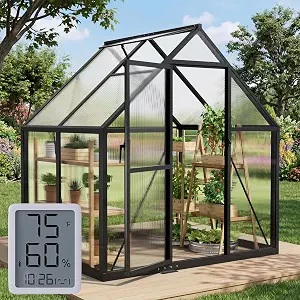
I rank the 6x4FT Greenhouse with Hygrometer as the best weather-ready compact kit because its aluminum frame, 4mm polycarbonate panels, and lockable door offer more lasting protection than the soft-cover VEVOR Walk-in Greenhouse. The included hygrometer and adjustable roof vents also make temperature and humidity easier to manage, which benefits gardeners raising seedlings or extending harvests through colder months. Its modest footprint fits smaller yards while still providing walk-in access. That stronger structure brings compromises: assembly requires more effort than setting up a portable greenhouse, and the panels can collect scratches over time. It also lacks the growing capacity and built-in systems of the EverBloom 6.5’x10′ Wooden Greenhouse. I place it below those larger permanent kits for space, but above portable models for year-round plant protection.
Pros:- Rigid aluminum and polycarbonate construction offers better weather protection than fabric-covered portable kits
- Adjustable roof vents support hands-on temperature and airflow control
- Included hygrometer helps gardeners monitor growing conditions
- Lockable door adds security and helps keep the enclosure closed during poor weather
Cons:- More time and effort to assemble than a soft-cover portable greenhouse
- 6×4-foot footprint limits shelving and working room for larger collections
- Polycarbonate panels may develop visible scratches with repeated handling or cleaning
Best for: Small-yard gardeners who want a compact, rigid greenhouse for seed starting, season extension, and year-round plant protection
Not ideal for: High-volume growers who need broad planting space, or renters who want a lightweight greenhouse that can be moved or stored quickly
- Footprint:6 x 4 ft
- Frame Material:Aluminum alloy
- Panel Material:Polycarbonate
- Panel Thickness:4 mm
- Panel Weight:580 g
- Environmental Monitor:Hygrometer
- Ventilation:Adjustable roof vents
- Door:Lockable
- Panel Protection:UV resistant
Our verdict“This is my pick for gardeners who need compact dimensions but prefer a rigid, weather-ready structure over a portable soft-cover greenhouse.”
How We Picked
I compared these kits by examining usable growing area, standing height, access, shelf layout, ventilation, water management, monitoring features, and the amount of site preparation each design appears to demand. I gave the most weight to features that affect daily growing rather than headline dimensions alone: room to work, ways to manage heat and humidity, and layouts that accommodate the intended plants. Build quality and weather readiness also shaped the ranking because a greenhouse that cannot be anchored appropriately or shed heat safely has limited practical value. Price context was treated as a balance between capability and complexity, not simply as a race toward the lowest listed cost.
That logic places EverBloom first overall for its middle-ground size and integrated growing systems, while Greengro earns the value role through a compact, accessible format. The tiered 56x55x74-inch kit ranks as my beginner option because it organizes many small plants, though its shelf-led layout is less adaptable to tall crops. VEVOR receives the narrow-space role, and the 6×4-foot kit stands apart for buyers who want a hygrometer without moving into a premium structure. Bellerose XL leads on capability, but its 13-by-11-foot size, site demands, and likely higher ownership commitment make it less broadly suitable than EverBloom.
| garden greenhouse kit | Frame Material |
|---|---|
| 56x55x74 Inch Greenhouse for O | Galvanized steel |
| Greengro Greenhouse | — |
| VEVOR Walk-in Greenhouse | Powder-coated steel |
| EverBloom 6.5’x10′ Wooden Gree | — |
| Backyard Discovery Bellerose X | — |
| 6x4FT Greenhouse with Hygromet | Aluminum alloy |
Factors to Consider When Choosing Garden Greenhouse Kits
The best greenhouse is not automatically the largest or most heavily equipped model. I would match the structure to the plants, the site, and the growing season before comparing accessories. These five buying factors help separate useful capacity from features that may add cost without improving the way a particular buyer gardens.
Match the Footprint to Usable Growing Space
Exterior dimensions do not reveal how much room remains after shelves, pots, and a walkway are added. I would mark the proposed footprint on the ground and reserve at least enough space to enter, turn, water, and reach plants without moving half the collection. Narrow walk-in kits work well against a fence or wall, but their central aisle can leave little room for broad containers. A tiered square model holds many seedling trays efficiently, while an open 6×4-foot or larger floor better accommodates tomatoes, grow bags, and climbing crops. Door swing, roll-up clearance, roof height, and nearby branches also affect where the structure can sit. A common sizing mistake is planning around today’s seedlings rather than the mature width and height of summer plants.
Choose the Structure for Local Weather
Portable covers, rigid panels, and wood-framed structures ask for different levels of anchoring and maintenance. A light enclosure can suit seasonal propagation, yet it needs a protected position and secure ground connections when wind is common. Rigid polycarbonate panels generally offer better long-term enclosure and light diffusion, while wood adds weight and visual appeal but requires periodic care. I would check the manufacturer’s wind and snow guidance rather than treating words such as windproof as a substitute for a published load rating. Anchoring is part of the greenhouse system, so the base, soil type, and drainage matter as much as the frame. Buyers in snowy areas should also plan for prompt roof clearing unless the structure carries a suitable snow-load specification.
Plan Heat and Humidity Control Before Planting
A greenhouse can overheat on a cool sunny day, which makes airflow more useful than many decorative extras. Roll-up doors and windows provide passive ventilation, but they depend on someone being present to open and close them. Automatic vents or an exhaust fan reduce that daily burden in a larger or more permanent greenhouse. A hygrometer helps reveal excessive humidity, yet it does not correct the problem by itself; the structure still needs airflow and sensible watering. I would prioritize controllable ventilation for crowded seedlings, tomatoes, and regions with strong spring sunshine. Shade cloth can also be a better summer purchase than a heater, especially when the primary goal is extending spring and fall rather than growing through winter.
Select Shelving Around the Plants
Built-in shelves can multiply propagation capacity, but they can also dictate what the greenhouse is able to grow. Closely spaced tiers favor seed trays, herbs, and compact pots, while tall crops need open floor area and overhead support. Removable or adjustable shelving gives a kit a longer useful life as plants move from germination to maturity. I would also check shelf depth and load limits before placing wet compost, ceramic pots, or water reservoirs on them. Access matters as much as capacity: a packed rear shelf that is difficult to water is not truly useful growing space. Buyers who want both seedlings and full-season vegetables may benefit from shelves along one side and an unobstructed bed or container zone on the other.
Budget for the Site and Ongoing Ownership
The kit price rarely represents the full cost of a permanent greenhouse. A level base, anchors, drainage work, irrigation fittings, electrical installation, staging, and replacement parts can change the final budget. Built-in hose connections and irrigation save setup time only when the garden already has a practical nearby water source. Power ports are useful for fans, lights, or heaters, but outdoor circuits should be installed and protected according to local electrical rules. I would pay more for durable framing and replaceable components when the greenhouse will remain outside all year. For a seasonal seed-starting shelter, simple construction and easy storage may offer better value than utilities that will seldom be used. Local setback, foundation, and permit rules should be checked before buying a large structure.
Frequently Asked Questions
Can a portable greenhouse stay outside during strong wind or snow?
I would not assume that any portable kit can handle severe weather solely because it is marketed for outdoor use. Proper anchors, a sheltered location, and a level base can improve stability, but they do not increase the frame’s published wind or snow rating. Covers should remain tight because loose material catches wind and places extra stress on the structure. Snow accumulation needs prompt removal unless the maker provides an adequate load specification. Buyers facing frequent storms may be better served by a rigid-panel wooden greenhouse or by treating a portable model as a seasonal structure.
What greenhouse size works best for seedlings and a few vegetable plants?
For seed trays and compact pots, a shelved enclosure around 28 to 56 inches wide can use a small area efficiently. Tall tomatoes, cucumbers, and grow bags need more floor area, vertical clearance, and room for airflow, making a 6×4-foot greenhouse a more flexible starting size. I would map the mature plants and preserve a usable aisle before choosing. Shelves can later be removed in some kits, but fixed tiers may limit that flexibility. When space permits, buying one size above the initial estimate often prevents crowding as the season advances.
Is a polycarbonate greenhouse worth paying more for than a covered portable kit?
Polycarbonate makes the most sense when the greenhouse will occupy a permanent site and receive regular use across several seasons. It offers a more rigid enclosure and better light diffusion than many flexible covers, but the frame, foundation, and panel fastening still determine overall durability. A covered kit costs less to enter, is easier to relocate, and can be adequate for seed starting or short season extension. Its cover may need earlier replacement and usually offers less resistance to harsh weather. I would pay the premium for polycarbonate when long-term growing space matters more than portability.
Are built-in irrigation and ventilation systems worth the extra cost?
They are most valuable for a buyer who grows frequently, travels, or struggles to maintain steady watering and temperature routines. Integrated irrigation reduces repetitive hand watering, while powered or automatic ventilation can limit heat buildup when nobody is nearby. These systems add fittings, controls, and maintenance points, so occasional growers may find manual watering and roll-up windows adequate. The benefit also depends on having convenient water and power access at the site. I would pay for automation that solves a recurring task, not simply because it lengthens the feature list.
Can any of these greenhouse kits support year-round growing?
A greenhouse can extend the season, but year-round production depends on climate, insulation, winter light, and the temperature needs of the plants. A rigid cedar-and-polycarbonate structure offers a better foundation for cold-season upgrades than a small portable cover, yet it may still need heat. Gaps, uninsulated bases, and frequent door opening can make heating expensive. Any heater or lighting setup needs weather-suitable equipment, safe electrical service, and enough ventilation to manage condensation. I would view year-round growing as a complete site system rather than a capability supplied by the kit alone.
Conclusion
For most committed home growers, I recommend the EverBloom 6.5’x10′ Wooden Greenhouse as Best Overall because it pairs useful working space with built-in irrigation and ventilation without demanding the enormous site of the premium model. The Greengro Walk-in Greenhouse is my Best Value choice for a slim, accessible setup, while the 56x55x74-inch three-tier greenhouse is Best for Beginners focused on seedlings and small pots. Buyers with a long, narrow location should choose the VEVOR Walk-in Greenhouse, accepting its lower 66.1-inch height and tighter working area. The 6×4-foot greenhouse is the better specific-needs pick for gardeners who want an open growing footprint and included humidity readings, though its hygrometer does not automate climate control. For maximum space, utilities, and permanent-garden appeal, the Backyard Discovery Bellerose XL is Best Premium, provided the buyer is ready for its larger footprint, site preparation, and upkeep. My final choice would follow the intended plants and local weather first, then the desired level of automation and permanence.
Halloween Picks
halloween
As an affiliate, we earn on qualifying purchases.