
TL;DR
Lawn care experts explain the distinctions between scarifiers and dethatchers, helping homeowners choose the right tool. The article covers confirmed facts and practical guidance for lawn maintenance.
Experts confirm that scarifiers and dethatchers are distinct lawn care tools used to remove thatch buildup, but they serve different purposes. This clarification aims to help homeowners choose the appropriate equipment for their lawn maintenance routines, which is important for effective lawn care.

Get garden gear delivered free with Prime
- Fast, free delivery on millions of items
- Prime Video, Amazon Music and more included
- Member-only deals all year
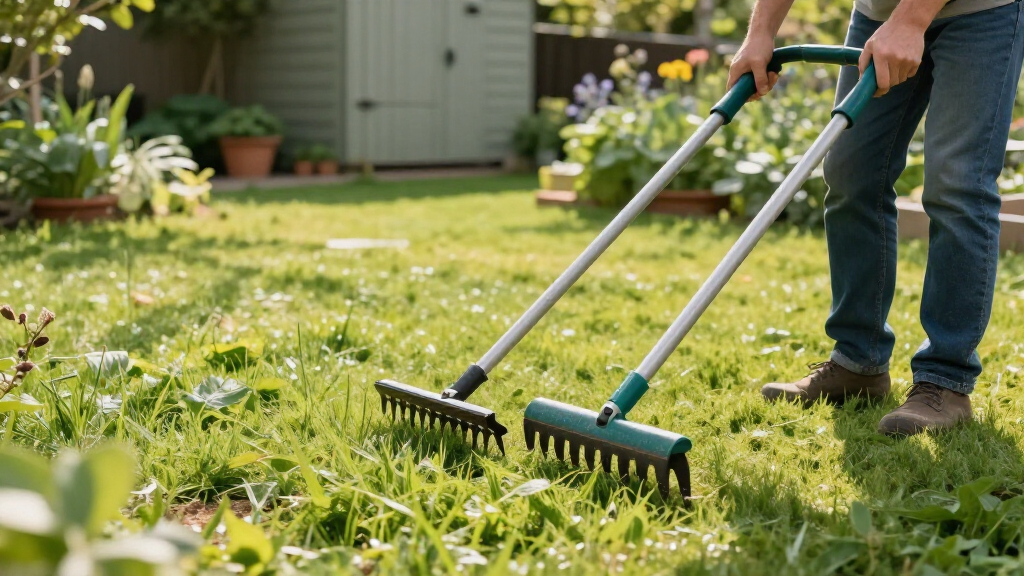
Scarifiers are designed to cut into the soil and remove thatch and moss, often using blades or tines that penetrate deeper into the turf. They are suitable for lawns with thick thatch layers or compacted soil, helping to improve aeration and promote healthy growth. Find out how often to mow your lawn. Dethatchers, on the other hand, primarily focus on removing a surface layer of thatch—dead grass and roots that accumulate above the soil—using a rake-like or mechanical blade system. They are best for lawns with light to moderate thatch buildup and are less invasive than scarifiers.
According to lawn care specialists, the choice between the two depends on the condition of the lawn. Learn more about lawn maintenance routines. Using a scarifier on a lawn with minimal thatch can damage the turf, while a dethatcher may be insufficient for severe thatch problems. Industry experts recommend assessing the thatch layer thickness before selecting the tool, with a layer over half an inch often indicating the need for scarification.
Why Correctly Choosing Between Scarifier and Dethatcher Matters
Understanding the difference between these tools is essential for effective lawn maintenance, preventing damage, and ensuring healthy turf growth. Using the wrong equipment can lead to over- or under-treatment, resulting in poor lawn health or unnecessary expense. Proper selection can improve aeration, nutrient absorption, and overall lawn appearance, saving homeowners time and money in the long run.
Products Worth Considering

Levoit Core 600S-P Smart Air Purifier for Large Rooms

Dyson Airwrap i.d. 6-in-1 Multi-Styler and Dryer

Levoit Vital 100S-P Air Purifier with Washable Pre-Filter
As an affiliate, we earn on qualifying purchases.
Historical and Practical Context of Lawn Scarification and Dethatching
Traditionally, lawn care involved manual raking to remove thatch, but modern equipment has evolved to include specialized tools. Scarifiers and dethatchers have become standard for professional and home use, with industry guidelines emphasizing the importance of matching the tool to the lawn’s specific condition. Experts have long debated the effectiveness of each, but recent discussions focus on clarifying their distinct roles and proper application.
Recent articles, including one from garden experts, highlight that misuse of these tools can lead to turf damage, emphasizing the need for proper assessment before treatment. The distinction has become more relevant as homeowners increasingly invest in lawn care equipment.
Unclear Guidelines for Optimal Lawn Treatment Practices
While experts agree on the general differences, there is still debate over precise thresholds for when to use each tool, and how often they should be applied. Some lawn care professionals suggest that overuse of scarifiers can damage turf, but specific recommendations vary depending on grass type and lawn condition. Further research is needed to establish standardized treatment protocols.
Next Steps for Homeowners and Lawn Care Professionals
Lawn care experts recommend conducting a thatch test—by removing a small section of turf and measuring the thatch layer—before using either tool. Manufacturers are expected to release updated guidelines on frequency and depth of scarification and dethatching. Homeowners should consult local lawn care professionals for tailored advice, especially in areas with specific grass types or climate conditions.
Key Questions
Can I use a dethatcher instead of a scarifier?
Only if your lawn has a light to moderate thatch layer. For deeper thatch or compacted soil, a scarifier is more appropriate.
How often should I dethatch or scarify my lawn?
The frequency depends on lawn condition. Typically, dethatching is done once a year, while scarifying may be needed less frequently, based on thatch buildup and soil health.
Is it safe to use these tools myself?
Yes, but proper technique and assessment are crucial. Overuse or improper use can damage the turf. Consulting a lawn care professional is advisable for best results.
What signs indicate I need to scarify or dethatch?
If you notice a thick layer of thatch (more than half an inch), or poor turf health despite regular watering and fertilizing, it may be time to use these tools.
Source: rss