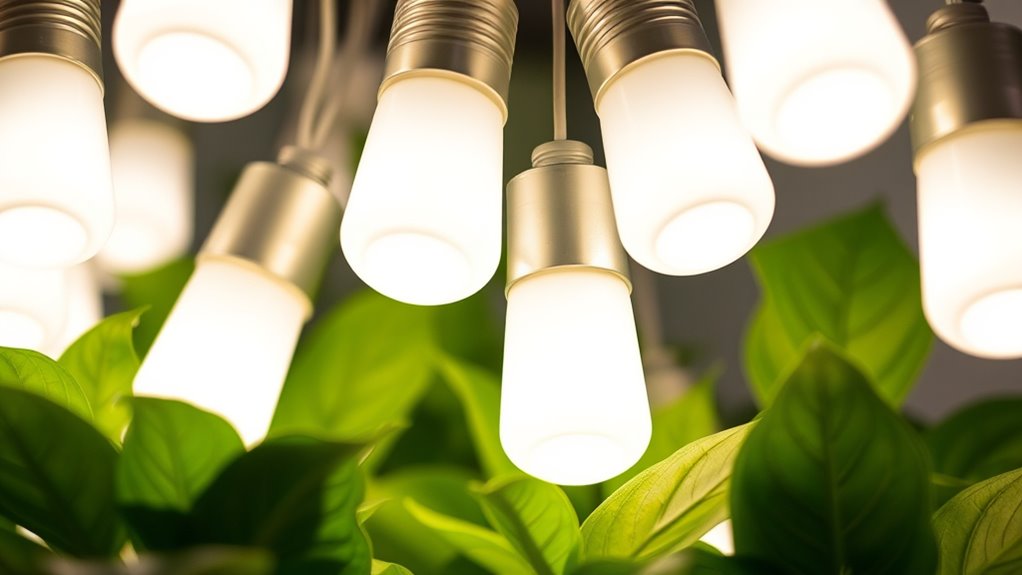
For most indoor plant owners seeking an E26 daylight LED grow bulb, I’d start with the SANSI 24W Full Spectrum 4000K Daylight bulb: it offers a useful step up in output from the many 10W options without jumping straight to a high-wattage bulb. The Barrina OG11A 11W is a sensible choice for modest supplemental lighting, while the SANSI 36W suits growers who need more output from a single bulb. The main tradeoffs are coverage versus intensity, single-bulb output versus multi-bulb flexibility, and whether features like water resistance matter for your placement. Read on for the full comparison of all 15 options and guidance on matching a bulb to your plants and fixture.

Get garden gear delivered free with Prime
- Fast, free delivery on millions of items
- Prime Video, Amazon Music and more included
- Member-only deals all year
Complete the kit


Key Takeaways
- SANSI dominates the wattage range: the lineup spans 10W to 36W, so shoppers can choose between modest supplemental light and a stronger single-bulb option without changing brands.
- The 24W options form the most flexible middle ground: several models pair full spectrum with 4000K daylight, while selected versions add IP54 protection or a stated 120° beam.
- Pack size changes the buying decision: SANSI’s 4- and 6-packs and Briignite’s 2- and 3-packs can make sense for multiple fixtures, while single bulbs suit targeted lighting.
- Daylight color temperature is not the whole spectrum story: a 4000K or 5000K label helps describe visible light, but full-spectrum design and the listed 660nm red light are separate distinctions.
- Higher wattage is not automatically better: the 36W and 300W-equivalent listings may suit larger or more light-demanding placements, but distance, fixture fit, and heat clearance still shape results.



| led grow bulb e26 daylight | Color temperature | Wattage | Base |
|---|---|---|---|
| SANSI LED Grow Light Bulbs 6-P | 4000K | 10W per bulb | E26 |
| Barrina OG11A 11W Full Spectru | 4000K | 11W | E26 |
| SANSI LED Grow Light Bulbs 4-P | 4000K | 10W per bulb | E26 |
| SANSI 300W Equivalent Full Spe | 5000K daylight | 30W | E26 medium |
| SANSI Grow Light Bulbs for Ind | 4000K | 24W | E26 |
| SANSI 60W Equivalent Full Spec | 5000K | — | E26; base not included |
| Briignite A19 Full-Spectrum LE | 3500K | — | E26 |
| Briignite A19 Full Spectrum LE | 3500K | — | E26 |
| SANSI Grow Lights for Indoor P | 4000K | — | E26 |
| Barrina OG11A Grow Light Bulbs | 4000K | — | E26 |
| SANSI 15W Full-Spectrum A19 LE | 4000K | 15W | — |
| SANSI 10W Full-Spectrum LED Gr | 4000K | 10W per bulb | — |
| SANSI 10W Full Spectrum Grow L | 4000K | 10W | — |
| SANSI 24W Full Spectrum LED Gr | 4000K | 24W | — |
| SANSI 24W Grow Light Bulb for | 4000K | 24W | — |
More Details on Our Top Picks
SANSI LED Grow Light Bulbs 6-Pack, 10W Full Spectrum, E26 Base, 4000K
The six-bulb bundle makes this SANSI a practical pick for spreading daylight-style grow lighting across several E26 fixtures. Its 4000K full spectrum spans 400–780nm, so the light is aimed at plant growth rather than serving as a general-purpose room bulb. Compared with the SANSI 4-Pack 10W, this set gives buyers more bulbs for a larger collection; compared with the SANSI 30W 5000K, each bulb is lower-powered and better suited to distributing light among separate plants than concentrating stronger output in one spot. Ceramic chip construction, a stated 25,000-hour lifespan, and ETL and CE certifications add useful durability and safety details. The tradeoff is a purpose-built grow bulb, not a flexible household replacement, and the product description does not give a brightness or beam-angle figure for planning coverage.
Pros:- Six bulbs support several fixtures or plants at once.
- Full spectrum output spans 400–780nm at a daylight-like 4000K.
- Ceramic chip construction is designed for efficient operation.
- Stated 25,000-hour lifespan and ETL and CE certifications.
Cons:- 10W per bulb may be insufficient for larger plants or a wide canopy without multiple fixtures.
- Designed for plant growth rather than general-purpose household lighting.
- No lumen output or beam angle is provided in the supplied specifications.
Best for: Indoor gardeners with several small-to-medium plants and multiple E26 sockets who want matching 4000K grow bulbs in one bundle.
Not ideal for: Buyers lighting a broad canopy from one fixture or seeking bulbs for ordinary room illumination; the 10W grow-focused output is better distributed across multiple sockets.
- Package quantity:6 bulbs
- Wattage:10W per bulb
- Base:E26
- Color temperature:4000K
- Spectrum:Full spectrum, 400–780nm
- Lifespan:25,000 hours
- Certifications:ETL, CE
- Material:Ceramic
Our verdict“Choose this six-pack when you need to distribute 4000K grow lighting across several E26 fixtures, not when one stronger bulb must cover a large area.”
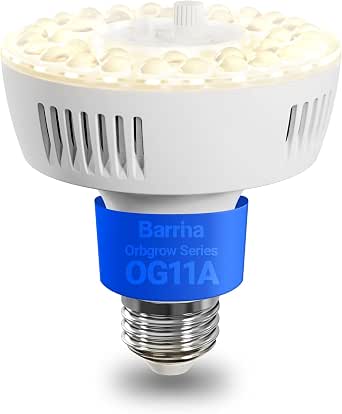
Barrina OG11A 11W Full Spectrum Grow Light Bulb, 4000K, E26, White
The stepless dimming and built-in timer make the Barrina OG11A the most hands-off option here for growers who want to control light intensity and daily run time at the bulb. It offers 4000K full-spectrum light, a CRI of 98, and a stated 1460 lumens; those figures make its white light easier to live with around indoor plants than a more specialized, stronger bulb such as the SANSI 30W 5000K. At 11W, it is also only modestly more powerful than the SANSI 10W multipacks, but it adds controls those bulbs do not list. The manufacturer gives a minimum canopy distance of 7.87 inches, so it is not a bulb to position very close to foliage. This is a single-bulb purchase, and its indoor-only designation limits where it fits.
Pros:- Stepless dimming allows brightness adjustment.
- Built-in 4-, 8-, and 12-hour timer settings simplify daily schedules.
- 1460 lumens and CRI 98 are specified alongside 4000K full-spectrum output.
- Standard E26 base fits many common fixtures.
Cons:- Sold as a single bulb rather than a multi-bulb pack.
- Manufacturer recommends keeping it at least 7.87 inches above the canopy.
- Intended for indoor use only.
Best for: Indoor plant owners with one E26 lamp who want adjustable brightness and timed daily lighting without adding a separate timer.
Not ideal for: Growers seeking a multi-bulb bundle, outdoor use, or close placement over short plants; the guidance calls for at least 7.87 inches above the canopy.
- Model:OG11A
- Package quantity:1 bulb
- Wattage:11W
- Base:E26
- Color temperature:4000K
- Light output:1460 lumens
- CRI:98
- Controls:Stepless dimming; 4-, 8-, and 12-hour timer settings
- Recommended minimum distance:7.87 inches (20 cm) above canopy
Our verdict“Pick the Barrina OG11A if adjustable brightness and timed operation matter more than buying multiple bulbs or maximizing wattage.”
SANSI LED Grow Light Bulbs 4-Pack, 10W Full Spectrum, E26 Base, 4000K
For a grower setting up a few plants rather than outfitting an entire shelf, this four-pack of 10W bulbs offers the same basic SANSI approach as the six-pack without as many spare bulbs. Its 4000K full-spectrum output, E26 base, and stated 25,000-hour lifespan match the core specifications of the larger bundle, while ceramic chip technology and ETL and CE certifications provide additional construction and safety details. Compared with the SANSI 6-Pack 10W, the smaller set suits a more limited fixture count; compared with the Barrina OG11A, it gives you multiple bulbs but has no listed dimmer or timer. The main limitation is power: each bulb is 10W, so a broad or light-hungry canopy may need multiple fixtures. No lumen or beam-angle figure is supplied to help estimate coverage.
Pros:- Four bulbs provide multi-fixture coverage in a smaller bundle than the six-pack.
- 4000K full-spectrum output is specified for plant growth.
- Ceramic chip technology is designed for efficiency and reliability.
- Stated 25,000-hour lifespan with ETL and CE certifications.
Cons:- 10W per bulb may call for multiple fixtures over larger plants or canopies.
- No built-in dimming or timer is listed.
- The supplied specifications do not state lumen output or beam angle.
Best for: New indoor gardeners with several E26 fixtures who want a coordinated set of low-wattage 4000K bulbs for a compact plant group.
Not ideal for: Owners of large plants or wide grow areas who need stronger output per fixture, or shoppers who want integrated dimming and timers.
- Package quantity:4 bulbs
- Wattage:10W per bulb
- Base:E26
- Color temperature:4000K
- Spectrum:Full spectrum
- Lifespan:25,000 hours
- Certifications:ETL, CE
Our verdict“Choose this four-pack for a compact collection across several E26 sockets, while larger setups are better served by more bulbs or a higher-wattage option.”
SANSI 300W Equivalent Full Spectrum LED Grow Light Bulb 5000K + 660nm E26 Base
With 30W of actual power and a supplemental 660nm red wavelength, this SANSI is the lineup’s more specialized choice for gardeners supporting flowering or fruiting plants. Its 5000K daylight appearance differs from the 4000K bulbs, including the SANSI 24W BR30, while the stated 336 µmol/s/㎡ PPFD at one foot gives buyers a useful intensity reference. It also has a 60-degree beam angle, concentrating light more than a broad general room bulb, so placement and coverage need planning. Compared with the lower-wattage SANSI 10W packs, it offers substantially more power in one E26 bulb; compared with the Barrina OG11A, it lacks dimming and timer controls. Its non-dimmable design means growers cannot turn down the output as plants change or when a fixture sits closer than intended.
Pros:- 30W actual wattage offers more output per bulb than the 10W SANSI packs.
- 660nm red supplement is aimed at supporting flowering and fruiting.
- PPFD is specified at one foot, helping with placement decisions.
- Chip-on-Ceramic construction and a stated 25,000-hour lifespan.
Cons:- Non-dimmable output cannot be adjusted for different plant stages or fixture distances.
- 60-degree beam concentrates light and may leave wider areas uncovered.
- Designed primarily for indoor use.
Best for: Indoor gardeners with flowering or fruiting plants who have a suitable E26 fixture and can position a concentrated, non-dimmable bulb at the right distance.
Not ideal for: Buyers needing adjustable output, broad-area illumination from one bulb, or a general household daylight bulb.
- Wattage:30W
- Equivalent wattage:300W
- Base:E26 medium
- Color temperature:5000K daylight
- Spectrum:Full spectrum, 380–780nm, with 660nm red supplement
- PPFD:336 µmol/s/㎡ at 1 ft
- Beam angle:60°
- Brightness:3000 lumens
- Lifespan:25,000 hours
Our verdict“Choose this SANSI for concentrated indoor lighting with a flowering-and-fruiting emphasis, provided you do not need dimming.”
SANSI Grow Light Bulbs for Indoor Plants, 24W Full Spectrum 4000K Daylight
The BR30 shape and 24W output make this SANSI a useful middle ground for growers who want more coverage from one E26 socket than the 10W SANSI multipacks can offer. It produces 2160 lumens of 4000K full-spectrum light and has a CRI of 95, giving it a daylight-like appearance while serving plants across growth stages. Compared with the SANSI 30W 5000K + 660nm, it uses less power and has a more familiar 4000K color, but it does not list a red supplement or a PPFD figure. The 60-degree beam angle concentrates light, so it is better suited to a defined plant area than a wide shelf; larger canopies may need multiple bulbs. ETL listing, Chip-on-Ceramic construction, a stated 25,000-hour lifespan, and a five-year protection plan add reassurance, though the E26 socket fit and beam spread still limit placement options.
Pros:- 24W output and 2160 lumens provide more listed brightness than the 10W SANSI bulbs.
- 4000K full spectrum with CRI 95 gives a daylight-like appearance.
- BR30 form and 60-degree beam focus light on a defined plant area.
- ETL listed, with a stated 25,000-hour lifespan and five-year protection plan.
Cons:- 60-degree beam may require multiple bulbs for a wide canopy.
- Requires an E26 fixture with enough space for its BR30 shape.
- No PPFD figure or dimming control is listed.
Best for: Indoor growers with a medium-sized plant grouping who want a higher-output 4000K E26 bulb and value specified brightness and CRI.
Not ideal for: People lighting a very wide canopy from one socket, or those who need a compact A19 bulb, adjustable output, or a listed PPFD measurement.
- Wattage:24W
- Bulb shape:BR30
- Base:E26
- Color temperature:4000K
- Brightness:2160 lumens
- CRI:95
- Beam angle:60°
- Lifespan:25,000 hours
- Warranty:5-year protection plan
Our verdict“Pick this 24W BR30 when one E26 fixture needs to serve a defined group of plants with brighter 4000K output than the 10W options.”
SANSI 60W Equivalent Full Spectrum LED Grow Light Bulb 5000K IP54 Waterproof
For a daylight-style E26 grow bulb that may face moisture, I’d put this SANSI ahead of the indoor-only Briignite A19 2-Pack. Its 5000K full spectrum includes supplemental 660nm red light, so it is designed to support plants across growth stages, including flowering and fruiting. The IP54 rating makes it the more suitable pick for humid areas or sheltered outdoor setups, though it does not make the bulb appropriate for every exposed installation. At 12W, it uses little power, but its stated PPFD is measured at just one foot, so placement matters when lighting a canopy. The ceramic heat sink and 25,000-hour stated life are appealing, but the bulb surface can get hot and the package does not include a base. That missing component makes setup less straightforward than with standard socket-ready picks.
Pros:- IP54 waterproof rating suits damp environments better than indoor-only options
- Full spectrum with 660nm supplemental red light supports multiple growth stages
- Low 12W power consumption
- Ceramic heat sink and stated 25,000-hour lifespan
Cons:- Base is not included, adding a separate setup requirement
- Bulb surface gets hot and should not be touched while operating
- PPFD figure is specified at one foot, so useful coverage depends on close placement
Best for: Plant owners needing a full-spectrum E26 bulb for a humid indoor area or a suitably sheltered outdoor location.
Not ideal for: Buyers who want a complete, ready-to-install bulb package or need broad, intense coverage for a large plant shelf.
- Power:12W
- Color temperature:5000K
- Base:E26; base not included
- Spectrum:Full spectrum with 660nm supplemental light
- PPFD:60.42 μmol/s/㎡ at 1 ft
- Water resistance:IP54
- Stated lifespan:25,000 hours
- Heat sink material:Ceramic
Our verdict“Choose this SANSI when moisture resistance and supplemental red light matter more than a simple, complete indoor setup.”
Briignite A19 Full-Spectrum LED Grow Light Bulbs, 2-Pack
I’d choose this Briignite pair for a small indoor setup where the grow bulb should look closer to ordinary warm-white lighting. Its 3500K appearance is warmer than the daylight-oriented SANSI 36W BR30, while its A19 shape fits standard E26 sockets and is less imposing in everyday fixtures. Two bulbs offer a useful way to spread light across nearby plants, and each is rated at 11W and up to 1,000 lumens. The tradeoff is that this is an indoor-only option, and its stated lifespan is inconsistent: the product details give both 25,000 and 30,000 hours. I would not choose it when clear lifecycle information or a cooler daylight look is the priority. Still, for home spaces where appearance matters alongside full-spectrum coverage, this is a more discreet alternative to the larger, brighter SANSI BR30.
Pros:- Two bulbs can light separate nearby fixtures or plant areas
- 3500K warm-white appearance blends more readily with home lighting
- Standard A19 shape and E26 base fit common sockets
- Full-spectrum output is intended for multiple plant growth stages
Cons:- Indoor use only
- Product information conflicts between 25,000- and 30,000-hour lifespan claims
- Lower stated lumen output per bulb than the SANSI 36W BR30
Best for: Indoor plant owners who want two standard-shape grow bulbs with a warm, home-friendly appearance for nearby plants.
Not ideal for: Buyers seeking outdoor use, a distinctly cool daylight color, or a reliably specified operating life.
- Pack size:2 bulbs
- Bulb shape:A19
- Base:E26
- Power:11W per bulb
- Color temperature:3500K
- Brightness:Up to 1,000 lumens per bulb
- Beam angle:180 degrees
- Stated lifespan:Conflicting claims: 25,000 and 30,000 hours
Our verdict“Pick this pair for modest indoor plant lighting where a warm-white look and two standard E26 bulbs matter more than daylight color or outdoor use.”
Briignite A19 Full Spectrum LED Grow Light Bulbs, 3-Pack
Among these options, this Briignite 3-pack is the practical choice when several small indoor plant areas need their own bulb. Each 11W A19 bulb uses a standard E26 base and produces up to 1,000 lumens, making it easier to distribute light across separate fixtures than relying on one high-output bulb such as the SANSI 36W BR30. The 3500K natural-white color is comfortable in living spaces, though it is warmer than the 4000K daylight-style Barrina OG11A. Full-spectrum output is intended for all growth stages, and the listing claims low heat and a 50,000-hour life. Those figures are attractive but should be treated as stated specifications, not a guarantee. This is strictly an indoor pick, and the listing’s mention of app control is not explained in the supplied details, so I would not buy it for smart features.
Pros:- Three bulbs make it easier to light multiple fixtures or plant locations
- Standard A19 form and E26 base suit common household sockets
- Full-spectrum light is intended for plants at all growth stages
- Natural-white appearance and stated low heat suit indoor rooms
Cons:- Indoor use only
- 3500K is warmer than the 4000K Barrina OG11A daylight-style option
- App control is mentioned without details explaining its operation
Best for: Indoor growers who want to equip three standard E26 fixtures for small plants or separate growing spots.
Not ideal for: Outdoor growers, buyers who need documented smart controls, or anyone lighting a broad canopy with one source.
- Pack size:3 bulbs
- Bulb shape:A19
- Base:E26
- Power:11W per bulb
- Color temperature:3500K
- Light output:Up to 1,000 lumens per bulb
- Color rendering index:90
- Stated lifespan:Up to 50,000 hours
Our verdict“Choose this Briignite pack to outfit several indoor E26 fixtures, but skip it if you need outdoor use or clearly documented app control.”
SANSI Grow Lights for Indoor Plants, 36W Full Spectrum LED Plant Light
For shoppers who mean daylight literally, I’d rank this SANSI above the warmer Briignite A19 bulbs: its 4000K natural daylight is closer to the requested color, and its 3,250-lumen output gives it a stronger single-bulb presence. The BR30 form and 36W draw make it better suited to a dedicated plant fixture than a subtle lamp used in a living room. A CRI of 95 helps colors appear more natural, while the ceramic technology and 25,000-hour stated life support a more substantial indoor setup. The cost of that output is higher power use than the 11W Barrina OG11A, and there is no dimming or smart control to fine-tune intensity. It is also primarily an indoor bulb, so I would not select it for exposed outdoor growing. For a brighter daylight-style E26 option, its output is the clearest differentiator.
Pros:- 4000K daylight color is closer to the roundup’s daylight focus than the 3500K Briignite bulbs
- 3,250 lumens provide substantial stated output from one bulb
- CRI 95 supports more natural-looking color
- Ceramic technology and a stated 25,000-hour lifespan
Cons:- 36W uses more power than the 11W Barrina OG11A
- No dimming or smart control features are specified
- Designed primarily for indoor use
Best for: Indoor growers who want a brighter single E26 bulb with a daylight color for a dedicated plant area.
Not ideal for: People seeking low-wattage accent lighting, dimming or smart controls, or a bulb for outdoor exposure.
- Bulb shape:BR30
- Base:E26
- Power:36W
- Color temperature:4000K
- Brightness:3,250 lumens
- Color rendering index:95
- Stated lifespan:25,000 hours
- Voltage:110V
Our verdict“Choose this SANSI for a brighter 4000K indoor plant fixture; choose a lower-wattage bulb if modest output and power draw matter more.”
Barrina OG11A Grow Light Bulbs for Indoor Plants, 4000K, 11W, 2 Pack
The Barrina OG11A is the most controllable option in this group: unlike the straightforward Briignite A19 bulbs, it offers stepless dimming and 4-, 8-, or 12-hour timer settings. That makes it a better fit for growers who want to adjust intensity or set a repeatable lighting window without adding separate controls. Its 4000K color matches the daylight angle of this roundup more closely than the 3500K Briignite packs, and the 98 CRI is the highest stated here. The listed PPFD is strong at 3.94 inches, but that close measurement comes with a practical limit: the bulb is specified for use at a minimum distance of 7.87 inches. Its 1,460 lumens exceed the Briignite’s 1,000 per bulb, yet a two-bulb pack may still fall short for a broad plant shelf. I’d favor it for a compact, managed setup rather than wide coverage.
Pros:- Stepless dimming allows intensity adjustment
- 4-, 8-, and 12-hour timer settings support scheduled operation
- 4000K color aligns better with daylight preferences than the 3500K Briignite bulbs
- CRI 98 and 1,460-lumen stated output per bulb
Cons:- Specified minimum use distance is 7.87 inches
- Two-bulb pack may not cover a larger growing area
- PPFD figure is measured very close to the bulb, at 3.94 inches
Best for: Indoor growers with a compact plant area who want built-in dimming and scheduled lighting from standard E26 fixtures.
Not ideal for: People lighting a large canopy with few bulbs or those unable to maintain the specified minimum distance from plants.
- Pack size:2 bulbs
- Power:11W per bulb
- Color temperature:4000K
- Base:E26
- Light output:1,460 lumens
- Color rendering index:98
- Dimming and timer:Stepless dimming; 4-, 8-, and 12-hour settings
- PPFD:1497.3 μmol/m²/s at 3.94 inches
- Specified minimum distance:7.87 inches (20 cm)
Our verdict“Pick the Barrina OG11A for a small indoor grow area where built-in scheduling and dimming are more useful than broad coverage.”
SANSI 15W Full-Spectrum A19 LED Grow Light Bulb
I’d rank this as the most balanced single-bulb choice for someone who wants an E26 daylight grow bulb with more output than the 10W SANSI A19, without moving to a larger 24W bulb. Its 4000K full spectrum is suited to everyday indoor plant lighting, while the optical lens and 60-degree beam focus more of the light toward plants than a broad room-filling bulb would. The listed 1050 lumens and 27 µmol/s PPF give useful output context, though they do not make this a substitute for a multi-bulb fixture over a large collection. Ceramic heat management and ETL listing add practical reassurance. Compared with the SANSI 10W two-pack, this is a simpler one-socket setup with higher per-bulb output, but it offers no second bulb for spreading light across separate plants and is indoor-only.
Pros:- Full-spectrum 4000K light is suited to indoor plant growth
- 1050-lumen output is higher than the listed 215-lumen SANSI 10W two-pack bulb
- Optical lens and 60-degree beam direct light toward plants
- Ceramic heat dissipation and ETL listing
Cons:- Indoor use only
- One bulb covers less area than a multi-bulb setup
- Output remains limited for larger plant canopies
Best for: Indoor plant owners who want one E26 bulb for a small growing area and prefer more output than a 10W bulb.
Not ideal for: People lighting several plants across a wide shelf, or anyone needing a bulb rated for outdoor use.
- Wattage:15W
- Bulb shape and base:A19, E26
- Color temperature:4000K
- Light output:1050 lumens
- PPF:27 µmol/s
- PPFD:152.83 µmol/s/m² at 1 ft
- Beam angle:60 degrees
- Use and certification:Indoor; ETL listed
Our verdict“Choose this single bulb for a small indoor growing spot when you want more output than SANSI’s 10W option without stepping up to a 24W BR30.”
SANSI 10W Full-Spectrum LED Grow Light Bulbs, 2-Pack
The case for this SANSI pack is coverage flexibility, not high brightness from either individual bulb. Two E26 bulbs let me light separate pots or place both over one compact area, which is harder to do with the single-bulb SANSI 15W A19. Each bulb uses 4000K full-spectrum light, a 60-degree beam, and an optical lens intended to direct light toward plants; the listed PPF is 16.8 µmol/s per bulb. The 5-year warranty and ceramic heat sink also distinguish this pair from options whose supplied details do not include a warranty. The tradeoff is that the listed white brightness is just 215 lumens per bulb, so this is a plant-focused choice rather than a bright room lamp. I’d skip it for broad shelves or larger plants that need more concentrated output.
Pros:- Two E26 bulbs can serve separate plants or be aimed at one compact area
- Full spectrum across the listed 400–780 nm range
- Optical lens and 60-degree beam help direct light toward plants
- Five-year warranty and 25,000-hour rated life
Cons:- Only 215 lumens of white brightness per bulb
- 10W per bulb provides less output individually than the SANSI 15W A19
- For indoor plant growing only
Best for: Plant owners with two small growing spots, or a compact shelf where two lower-wattage bulbs can be positioned independently.
Not ideal for: Buyers who need strong illumination from one socket or want a bulb that also brightly lights a room.
- Pack size:2 bulbs
- Wattage:10W per bulb
- Bulb shape and base:PAR20, E26
- Color temperature:4000K
- Spectrum:Full spectrum, 400–780 nm
- PPF:16.8 µmol/s per bulb
- Brightness:215 lumens per bulb
- Beam angle:60 degrees
- Warranty:5 years
Our verdict“Pick this pair when positioning two modest-output bulbs matters more than getting the stronger single-bulb output of the SANSI 15W A19.”
SANSI 10W Full Spectrum Grow Light Bulb for Indoor Plants, 4000K Daylight, E26 Base
This is the most conventional fit in the group: a 10W A19 with an E26 base, so buyers can use a familiar bulb shape in a compatible standard socket. Its listed 900 lumens and CRI 95 make it more suited to a plant corner that also needs pleasant-looking white light than the SANSI 10W PAR20 two-pack, whose listed brightness is 215 lumens per bulb. Both use 4000K full-spectrum light, but this A19 is sold singly and offers no second bulb for distributing light across separate plants. The 60-degree beam is relatively focused, so placement matters; the product data says it works best in direct proximity to plants. Its 25,000-hour lifespan and 5-year warranty are helpful, while the lack of dimming limits adjustment as plants or setups change.
Pros:- Standard A19 shape and E26 base fit many compatible household sockets
- 900-lumen output and CRI 95 provide useful visible white light
- 4000K full-spectrum light for indoor plant growing
- 25,000-hour lifespan and 5-year warranty
Cons:- No dimming or adjustable features
- 60-degree beam and close-placement guidance limit flexible coverage
- Indoor-focused design offers limited outdoor versatility
Best for: Buyers who want one familiar A19-shaped grow bulb for a nearby plant in a standard E26 fixture.
Not ideal for: People who need adjustable brightness, broad coverage, or a bulb suited to outdoor growing.
- Wattage:10W
- Bulb shape and base:A19, E26
- Color temperature:4000K
- Brightness:900 lumens
- Color rendering index:95
- Beam angle:60 degrees
- Efficiency:1.68 µmol/J
- Lifespan:25,000 hours
- Warranty:5 years
Our verdict“Choose this single A19 when a familiar bulb shape and stronger visible brightness matter more than the two-point coverage of the SANSI 10W PAR20 pack.”
SANSI 24W Full Spectrum LED Grow Light Bulb, 4000K, IP54 Waterproof, 120° Beam
Among these five, this BR30 is the clearest choice when wide coverage from one bulb matters more than a compact A19 profile. Its 120-degree beam spreads light broadly across nearby plants, unlike the 60-degree SANSI 15W A19, which is better suited to aiming at a smaller target. At 24W, it also steps up in power from the 10W options. That broad pattern can reduce the need to aim several narrow-beam bulbs, but the supplied specifications do not list lumen output or PPF, so buyers have less data for comparing plant-light intensity directly. The product title identifies IP54 waterproofing, though the detailed specs emphasize indoor use; I would not treat that as a general outdoor rating. The bulb surface gets hot, so placement and clearance matter.
Pros:- Wide 120-degree beam spreads light across multiple nearby plants
- 24W output class is higher than the listed 10W and 15W alternatives
- 4000K full-spectrum illumination
- Ceramic technology supports heat dissipation
Cons:- Bulb surface gets hot and needs clearance from plants and surrounding materials
- Supplied specs do not state lumen output or PPF
- Primarily intended for indoor use despite IP54 in the product title
Best for: Indoor growers with a small group of nearby plants who want a broad beam from one E26 bulb.
Not ideal for: Buyers needing quantified PPF or lumen output, a narrow spotlight effect, or a bulb for outdoor exposure.
- Wattage:24W
- Equivalent wattage:200W
- Bulb shape and base:BR30, E26 medium
- Color temperature:4000K
- Beam angle:120 degrees
- Light type:Full-spectrum LED
- Use:Plant growing; primarily indoor
Our verdict“Choose this BR30 for broad indoor coverage across nearby plants, but favor the SANSI 15W A19 if you need stated PPF and a narrower beam.”
SANSI 24W Grow Light Bulb for Indoor Plants, 300W Equivalent, Full Spectrum
This 24W SANSI is the higher-power daylight pick for buyers who want more than the 10W A19 or two-bulb PAR20 options can provide from each socket. It uses 4000K full spectrum across 400–780 nm and lists a 300W-equivalent rating, plus a 25,000-hour lifespan. Compared with the other 24W SANSI BR30 in this group, this bulb’s supplied data gives a spectrum range and safety details but does not provide a beam angle, lumen figure, PPF, or a shape and base. That leaves less guidance for matching it to a fixture and judging plant-level output before buying. Ceramic construction, reinforced insulation, flame-retardant material, and ETL and CE certifications add safety-oriented details; still, the description says proper fixture fit is needed, and the initial cost may exceed standard grow bulbs.
Pros:- 24W full-spectrum light with a stated 4000K daylight color temperature
- 300W-equivalent rating provides a higher-power option than the 10W bulbs
- 25,000-hour lifespan
- ETL and CE certifications with flame-retardant and reinforced-insulation features
Cons:- Supplied data omits lumen output, PPF, and beam angle
- Bulb shape and base are not specified in the provided product data
- Requires a compatible fixture and may cost more than a standard grow bulb
Best for: Indoor growers seeking a higher-wattage full-spectrum bulb and who can confirm their fixture accommodates the bulb.
Not ideal for: Shoppers who need a stated beam angle, PPF, lumen output, or explicit E26/base and bulb-shape details before choosing.
- Wattage:24W
- Equivalent wattage:300W
- Color temperature:4000K
- Spectrum:Full spectrum, 400–780 nm
- Lifespan:25,000 hours
- Material:Ceramic
- Certifications:ETL, CE
- Safety features:V0 flame retardant, reinforced insulation, anti-corrosion shell
Our verdict“Consider this 24W bulb when higher power and safety details matter most, but choose the BR30 instead if you want a specified wide beam.”
How We Picked
I compared the 15 listed bulbs by the details that most affect a real E26 grow-light setup: wattage and stated output positioning, full-spectrum and daylight specifications, bulb shape and base, pack size, and added features such as water resistance or a beam-angle claim. I gave priority to clear fit for a common use case rather than treating the highest wattage or largest equivalent claim as an automatic win. I also separated compact supplemental bulbs from higher-output choices so readers can match the bulb to their plant count, fixture, and available clearance.
The order reflects versatility and decision clarity. The SANSI 24W 4000K daylight option leads as a middle-ground pick; the 10W and 11W bulbs rank well for gentle supplemental lighting and multi-fixture coverage, while the 36W and 300W-equivalent models are aimed at buyers prioritizing more output. Pack versions are judged by how useful they are for outfitting several sockets, not by assuming that a larger pack improves plant performance. Where listings provide limited detail, I avoid treating missing specifications as proof of an advantage.
Factors to Consider When Choosing Led Grow Bulb E26 Daylight
Choosing an E26 daylight grow bulb is less about finding the largest number on the package and more about matching light delivery to the plant, fixture, and room. These broader checks can prevent common mismatches that a product name alone will not reveal.
Match Light Output to the Plant and Growing Area
Start by estimating how many plants need supplemental light and how far they sit from the bulb. A lower-wattage bulb can be a practical fit for one small plant or a nearby shelf, while a wider grouping may need more than one socket or a higher-output model. Do not treat “equivalent watts” as the bulb’s actual electrical draw; compare the stated wattage and any usable output information separately. A single powerful bulb may create a bright center with weaker light at the edges, while multiple modest bulbs can spread light more evenly. If the listing does not provide a clear coverage area, plan to adjust height and observe how the plants respond rather than assuming a fixed footprint.
Read Daylight and Full-Spectrum Claims Separately
A 4000K or 5000K label describes the appearance of visible light, not a complete measure of how useful the bulb is for plant growth. “Full spectrum” is a broader product claim, and some listings identify added wavelengths such as 660nm red light. These details can help distinguish bulbs, but they do not replace information about output or coverage. Daylight-toned bulbs are often easier to live with in rooms where people spend time, since their visible color can feel more natural than strongly colored grow lighting. Avoid choosing solely by color temperature: two bulbs with similar daylight labels may differ in wattage, beam spread, and stated spectrum.
Check Fixture Fit, Heat Clearance, and Socket Limits
An E26 base fits many standard sockets, but that does not guarantee every bulb will fit every lamp. Check the bulb’s shape and dimensions against shades, enclosed fixtures, clamp lamps, and nearby shelves. Confirm that the fixture supports the bulb’s actual wattage and that the bulb is approved for the way the fixture is used; an equivalent-watt claim does not set the electrical load. Leave space around higher-wattage bulbs for heat to dissipate, and avoid crowding foliage against the light. If a bulb’s dimensions or enclosed-fixture guidance are absent, verify those details before buying rather than relying on the base type alone.
Choose Pack Size Around Your Layout, Not Just the Number of Bulbs
Multi-packs are useful when several plants share similar lighting needs or when you have multiple compatible fixtures. They can also make it easier to keep bulb type consistent across a shelf. A single bulb is often the better choice when you are testing one placement, replacing a failed bulb, or lighting a plant with different needs from the rest. Before selecting a pack, count usable sockets and consider whether each bulb can be positioned at an appropriate distance. Buying more bulbs than your setup can place well may leave you with uneven or excessive lighting rather than better coverage.
Decide Whether Water Resistance Is Relevant
Some bulbs in this group list IP54 protection, which may be useful in locations where splashes or dust are a concern. That rating should not be read as permission to submerge a bulb or use it in any exposed outdoor fixture. Check the manufacturer’s use instructions and the rating of the complete fixture, since the bulb is only one part of the electrical setup. For a dry living room or plant shelf, water resistance may add little practical value compared with beam spread or output. Buyers should pay attention to this feature when the placement creates a real exposure concern, not simply because the specification appears on the package.
Plan Light Distance and Daily Use Before Paying for More Output
Higher output can help when plants are farther from a bulb or when a setup needs more light, but distance changes how much reaches the leaves. Moving a bulb closer may improve delivery, though too little clearance can cause heat stress or uneven exposure. Think through how the light will be switched on and off each day; a timer can keep a consistent schedule without requiring a more powerful bulb. If plant response is uncertain, begin with a conservative placement and adjust gradually while watching for stretched growth or signs of light stress. Paying more for output is most useful when your area, fixture, and distance can actually make use of it.
Frequently Asked Questions
Is a 4000K bulb always a better daylight choice than a 5000K bulb?
No. The Kelvin number mainly describes the visible color of the light, with 4000K generally appearing less cool than 5000K. It does not tell you by itself how much useful light reaches your plants or how broad the spectrum is. Compare wattage, spectrum details, beam spread, and placement alongside color temperature. If the bulb will also light a room used by people, choose the visible tone you find more comfortable, provided the bulb otherwise fits your plant-lighting needs.
Should I choose one 24W or 36W bulb instead of several 10W bulbs?
That depends on how your plants are arranged and how many compatible sockets you have. A stronger single bulb may be simpler for one concentrated area, while several lower-wattage bulbs can distribute light across a wider shelf or multiple plants. Compare the total actual wattage, fixture limits, spacing, and the bulbs’ beam patterns rather than relying on equivalent-watt claims. If you cannot position a single bulb evenly over the whole group, multiple sockets may be the more practical arrangement. For a small, tightly grouped area, one higher-wattage bulb may reduce setup complexity.
Can I use an E26 grow bulb in an ordinary desk lamp?
Often the base will fit, but socket compatibility alone is not enough to confirm safe use. Check the lamp’s wattage limit, the bulb’s size, and whether the fixture is open or enclosed according to the manufacturer’s instructions. A shade can block or redirect light, and a compact lamp may not leave enough room around a larger or higher-wattage bulb. Aim the bulb so it reaches the plant rather than the room, and keep leaves far enough away to avoid heat or light stress. If the lamp’s guidance does not cover the bulb type or wattage, use a fixture with clearly compatible specifications.
Does IP54 mean I can use a grow bulb outdoors or near a watering area?
Not by itself. IP54 on a bulb indicates a stated level of protection, but it does not make the bulb waterproof or certify the socket, lamp, wiring, and outlet for outdoor use. Water exposure can affect the complete fixture even if the bulb has a protection rating. Follow the bulb maker’s instructions and use a fixture specifically rated for the location. For ordinary indoor plant shelves, this feature may matter less than fit, light distribution, and safe clearance.
How do I know whether to buy a single bulb or a multi-pack?
Choose a single bulb if you are lighting one plant, replacing a bulb, or still deciding how a particular location responds to supplemental light. A multi-pack makes more sense when several sockets are ready and the plants have similar needs. Count the fixtures you can use safely, then consider whether the bulbs can be spaced to cover the plants evenly. A larger pack does not solve inadequate coverage if all the light is concentrated in one spot. Starting with fewer bulbs can be a useful way to learn what your setup needs before expanding.
Conclusion
For the best overall balance, I’d choose the SANSI 24W Full Spectrum 4000K Daylight bulb, which sits between the low-wattage options and the more demanding high-output choices. For best value across several sockets, the SANSI 10W multi-packs make sense when you want consistent bulbs for multiple small plants; the Barrina OG11A is a straightforward alternative for modest supplemental lighting. For a premium, higher-output direction, look at the SANSI 36W or 300W-equivalent models, after checking fixture fit and plant distance. Beginners may find an 11W or 10W bulb easier to place in a standard lamp while learning how their plants respond. For specific needs, choose an IP54-listed 24W model when the location warrants added splash protection, or a multi-pack when your shelf has several suitable sockets. The right pick is the one your fixture can support and your plants can use at the distance you can provide.
Fall Picks

eufy Security Essential 7-Piece Alarm System
As an affiliate, we earn on qualifying purchases.