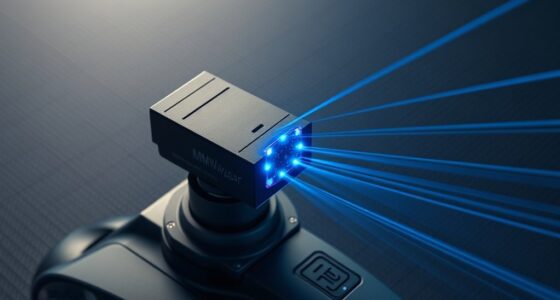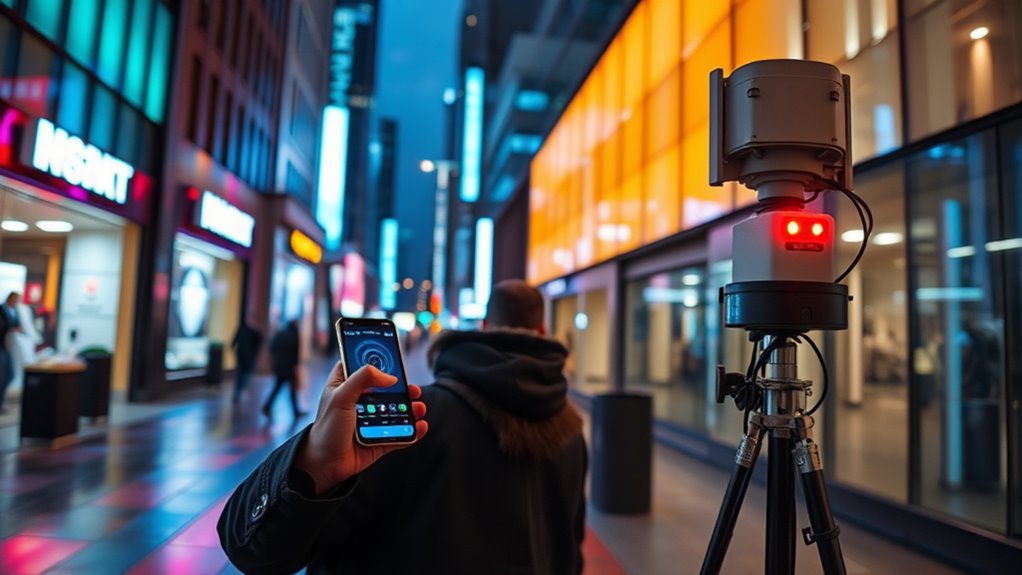

Presence detection using phones, beacons, and mmWave signals allows your devices and environments to recognize when you’re nearby. Phones emit Bluetooth and Wi-Fi signals, beacons broadcast identifiers, and mmWave uses high-frequency waves for precise location tracking. Together, these technologies enable seamless automation like lighting, heating, or security adjustments. They also raise privacy concerns, but with proper safeguards, you can benefit from smarter spaces. Keep exploring to discover how these systems work more closely.
Key Takeaways
- Presence detection systems utilize phones, beacons, and mmWave signals to identify occupancy and automate environmental controls.
- Phones emit Bluetooth or Wi-Fi signals that systems detect as personal identifiers for presence tracking.
- Beacons broadcast signals that sensors pick up to determine location and presence within a space.
- MmWave technology employs high-frequency signals for precise, real-time indoor presence detection.
- Combining these technologies enhances detection accuracy while raising privacy and data security considerations.

Have you ever wondered how devices automatically turn on lights or adjust temperature when you enter a room? It’s all thanks to presence detection technologies that recognize your presence without any manual input. These systems rely on sensors, beacons, and mmWave signals to determine if someone is there, enabling seamless automation. As you walk into a space, your devices analyze various signals to decide whether to activate or stay dormant. The key to their effectiveness lies in sensor accuracy, which ensures the system correctly detects your presence without false alarms or misses. High sensor accuracy means fewer misfires, so your lights won’t turn on when you’re not around, and your thermostat adjusts precisely when you arrive. However, achieving this level of precision isn’t always straightforward. Different sensors have varying capabilities, and environmental factors like furniture or other electronic devices can influence detection accuracy. That’s why manufacturers continually refine sensor technology to improve reliability. Additionally, advancements in sensor technology contribute significantly to increasing the overall effectiveness of presence detection systems.
At the same time, privacy concerns are a substantial aspect of presence detection systems. You might wonder what data is being collected and how it’s used. Many of these systems track signals emitted by your phone, beacon signals, or mmWave waves to detect your presence. While these methods can be incredibly effective, they also raise questions about user privacy. Some people worry about being constantly monitored or about their location data being stored or shared without clear consent. Responsible deployment involves transparency, ensuring users understand what data is gathered and how it’s protected. Companies are increasingly implementing encryption and anonymization techniques to address these privacy concerns, but the debate about data security remains ongoing. You should feel confident that your presence detection system respects your privacy while providing convenience.
Furthermore, the integration of phones, beacons, and mmWave technology offers a versatile approach to presence detection. Phones serve as personal identifiers, signaling their owner’s presence via Bluetooth or Wi-Fi, while beacons broadcast specific signals that detection systems can pick up. MmWave technology adds another layer by using high-frequency signals to precisely locate and track movement in a space. This combination enhances sensor accuracy, making detection more reliable and responsive. However, it also emphasizes the importance of balancing technological advancement with privacy safeguards. When you’re aware of how these systems work and the measures taken to protect your data, you can enjoy the benefits of automatic lighting, climate control, or security features without feeling uneasy. In the end, presence detection is about creating smarter, more responsive environments—if you understand the technology and trust its safeguards, it can profoundly improve your everyday interactions with your surroundings.

SwitchBot Smart mmWave Radar Motion Sensor, Bluetooth Presence Sensor with Dynamic Detection & Zone Positioning, Compatible with Alexa, HomeKit & Apple Home via SwitchBot Hub (Presence Sensor)
Motion & Presence Detection: Presence Sensor combines mmWave radar with light-sensing technology and PIR sensor to accurately detect…
As an affiliate, we earn on qualifying purchases.
As an affiliate, we earn on qualifying purchases.
Frequently Asked Questions
How Accurate Is Mmwave for Presence Detection Compared to Other Methods?
You’ll find mmwave highly accurate for presence detection, offering superior sensor accuracy compared to other methods. Its signal reliability remains strong even in complex environments, reducing false positives and negatives. Unlike simple Bluetooth or Wi-Fi signals, mmwave’s high-frequency waves provide precise spatial data, making it ideal for real-time detection. Overall, it outperforms many traditional methods, especially when you need detailed, reliable presence information in dynamic settings.
What Are the Privacy Implications of Using Beacon-Based Presence Detection?
You should consider that beacon-based presence detection raises privacy concerns because it can collect data privacy information without your explicit consent. While it often aims to protect user anonymity, there’s always a risk that your location or behavior data could be linked back to you. To safeguard your privacy, guarantee systems implement strong data privacy policies and anonymize user data, minimizing the risk of misuse or unauthorized tracking.
How Does Environmental Interference Affect Mmwave and Beacon Signals?
Environmental interference can substantially impact mmwave and beacon signals through signal degradation, making detection less reliable. Factors like walls, metal objects, and weather conditions cause interference, disrupting signal transmission. To combat this, you can use interference mitigation techniques such as adaptive filtering, beamforming, and frequency hopping. These methods help maintain accurate presence detection, ensuring signals stay strong and reliable despite environmental challenges.
Can Presence Detection Systems Differentiate Between Humans and Pets?
Yes, presence detection systems can differentiate between humans and pets by using animal recognition algorithms. These systems analyze movement patterns, size, and thermal signatures to identify animals accurately. They also incorporate false positive mitigation techniques to prevent false alarms caused by pets. By combining advanced sensors and intelligent software, you can guarantee your system reliably detects human presence while minimizing errors from animals, enhancing security and automation in your space.
What Are the Cost Considerations for Implementing Advanced Presence Detection?
Implementing advanced presence detection is like planting a high-tech garden; initial installation costs can be steep, requiring investment in sensors, software, and integration. You’ll need to contemplate ongoing maintenance expenses to keep everything running smoothly, just as tending a garden demands regular care. While upfront costs may seem significant, the long-term benefits of accuracy and automation can outweigh these expenses, making your system both efficient and cost-effective over time.

Blue Charm Beacons – Bluetooth BLE iBeacon (BC011-MultiBeacon) – Shows Battery Level in Broadcast – Long Range BLE 5.0
This compact beacon includes all of the usual beacon features as well as a button trigger option. Long…
As an affiliate, we earn on qualifying purchases.
As an affiliate, we earn on qualifying purchases.
Conclusion
By now, you’ve seen how phones, beacons, and mmWave technologies revolutionize presence detection. Did you know that over 90% of retail stores using beacon technology see increased customer engagement? This shows how advanced detection methods not only enhance safety and security but also boost business insights. As these technologies evolve, expect even smarter environments that respond seamlessly to your presence, making everyday interactions more intuitive and efficient.

GoveeLife Human Presence Sensor, 2.4 GHz Wi-Fi Required, Smart mmWave Radar & PIR Wired Motion Sensor, Zone Positioning, Multi-Person Detection, Support Alexa & Google Home, for Indoor Home Automation
Ultra-High Accuracy Presence Detection: Presence Sensor utilizes mmWave radar and infrared technology to detect human movement and static…
As an affiliate, we earn on qualifying purchases.
As an affiliate, we earn on qualifying purchases.

meross Matter Human Presence Sensor, 3-in-1 PIR & Light & mmWave Radar Motion Sensor, AI Motion Detector for Matter Smart Home Automation, Supports HomeKit, Alexa, Google, Home Assistant, 2.4GHz Wi-Fi
Radar+PIR+Light 3 in 1 sensor: Combined with PIR and millimeter wave radar, meross HomeKit motion sensor offers significant…
As an affiliate, we earn on qualifying purchases.
As an affiliate, we earn on qualifying purchases.