
TL;DR

Get garden gear delivered free with Prime
- Fast, free delivery on millions of items
- Prime Video, Amazon Music and more included
- Member-only deals all year
A Gardening Know How report says turning off an irrigation system does not remove water trapped in its pipes, valves and sprinkler heads. Homeowners should winterize before a hard freeze, using the drainage method suited to their system or a carefully controlled compressed-air blowout; the report advises hiring a professional when the setup or procedure is uncertain.
Turning off an in-ground sprinkler system may not protect it from freeze damage, according to a Gardening Know How report, because water can remain in pipes, valves, sprinkler heads and the backflow preventer. The report advises homeowners to winterize before their area’s first hard freeze, with the right approach depending on the system and local climate.
Closing the water supply stops new water from entering, but it does not necessarily clear water already in the system. The report says that when water freezes at 32°F (0°C), it expands by about one-eleventh. That expansion can crack sprinkler casings and valves or split pipe and fittings. Water may be held in buried low points, where shifting soil can leave sections of pipe that do not drain evenly.
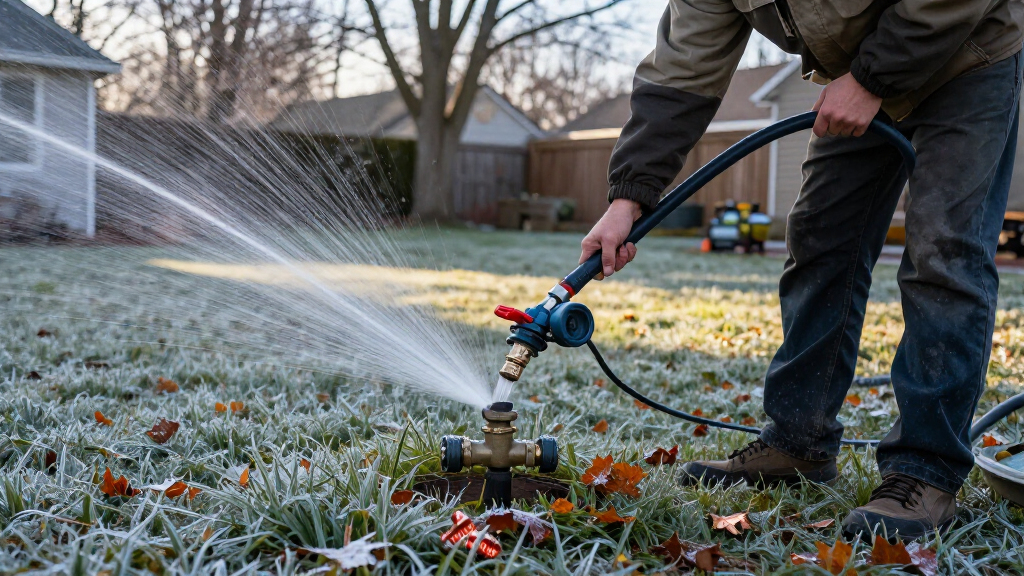
Where a system has a blowout port, the report describes using an air compressor to push water out one irrigation zone at a time. It says to close the water supply, connect the compressor at the blowout fitting downstream of the backflow preventer, and avoid sending air back through the backflow device. Open a zone before applying air, increase pressure gradually, and stop when only a fine mist and air emerge from the heads. The report recommends two passes per zone and turning off the compressor before changing zones.
Safety matters: the report calls for safety glasses and keeping people clear of sprinkler heads, risers and valve boxes while the system is pressurized. It warns against excessive pressure and prolonged blowing through already-cleared lines, which may damage components. After the work, it says to leave the backflow preventer’s ball valves and test cocks half-open. Homeowners should drain pumps and store them indoors, and should not force stuck valves or fittings.
Preventing Freeze Damage to Irrigation
Water left behind can turn a routine spring start-up into a repair job. A cracked valve, fitting or sprinkler case may not be apparent until the system is switched on again, when leaks can waste water and require parts or professional service. The report’s central point is that a shutoff valve is not the same as draining the system.
Winterization also involves a trade-off: compressed air can clear water from places drains may miss, but poorly controlled air can damage the system or injure someone. The guidance makes the method and pressure appropriate to the specific system, and the homeowner’s ability to operate it safely, central to deciding whether to do the work independently or hire a specialist.
Products Worth Considering

eufy Security Essential 7-Piece Alarm System

Coway Mighty AP-1512HH(W) Air Purifier, White

Ring Alarm 5-Piece Wireless Security System
As an affiliate, we earn on qualifying purchases.
Timing Depends on Local Freeze Risk
The report recommends finishing winterization before the first hard freeze. In colder areas, that often means early to mid-fall. It says an established lawn can be shut off somewhat early without lasting harm, as it should green up again after watering resumes in spring.
Exposure differs across a system. Above-ground backflow preventers and exposed pipes face freezing air first; buried lines are more vulnerable after prolonged cold drives frost deeper into the soil. The report says some mild-winter regions use systems without a blowout port, where shutting off the supply, turning off the controller and draining exposed parts may be sufficient. The appropriate procedure therefore varies with system design and local conditions.
“A shutoff valve keeps new water out, but the water in the pipes, valves, and heads stays put.”
— Gardening Know How report
System Design Determines the Method
The report does not establish one winterization procedure for every irrigation system. Whether a system has manual drains or a blowout port, how its lines are routed, and how cold the local ground gets all affect what is needed. It also does not give a single safe pressure setting for every installation; its estimate of about 5 CFM for many residential systems is presented for blowing out one zone at a time, not as a universal specification.
Homeowners who cannot identify the correct shutoff, drain points or compressor connection should not guess. The report says some systems are better handled by a professional. It also warns against forcing valves and against applying air through a closed valve, but does not provide a model-specific procedure for every controller, backflow preventer or pump.
Check the System Before Cold Weather
Homeowners should identify their system’s water shutoff, drain points and any blowout port before freezing weather arrives. They should check manufacturer instructions and local guidance to determine whether manual draining is appropriate or whether a controlled blowout is needed. If the layout is unfamiliar or the proper equipment and safe operating procedure are unclear, contacting an irrigation professional is the safer next step.
After winterization, keep the controller off and confirm that exposed components and pumps have been drained or protected as directed for the system. The next test comes in spring, when the system can be inspected for leaks or freeze damage before regular watering resumes.
Key Questions
Is turning off the sprinkler water enough for winter?
Not necessarily. The report says water can remain in pipes, valves, heads and the backflow preventer after the supply is shut off. That trapped water may freeze and damage components.
When should I winterize my sprinkler system?
Complete the work before your area’s first hard freeze. The report says colder regions often do this in early to mid-fall, but timing depends on local weather.
Can I blow out the system with an air compressor?
The report describes a compressor blowout for systems with a suitable port, using air gradually and one zone at a time. Follow the system’s instructions; excessive pressure or blowing through dry lines for too long can cause damage.
What safety precautions should I take?
Wear safety glasses, keep clear of sprinkler heads and valve boxes while air is on, and open a zone before starting the compressor. Keep pets indoors if sudden noise may startle them. Do not force a stuck valve or send air through a closed valve.
Do all sprinkler systems need a blowout?
No single method applies to every system. The report says some systems in mild-winter regions may need only the supply shut off and exposed components drained. System design and local freeze conditions determine the appropriate approach.
Source: rss