
TL;DR
Beijing’s Garden Bureau has successfully implemented a micro-pore trunk injection technique to control the spread of American white moth in tall urban trees. This innovative method addresses previous challenges in pest management for large trees, marking a significant step in urban forestry health efforts.
Beijing’s Garden Bureau has introduced a novel micro-pore trunk injection technique to combat the spread of American white moth in tall urban trees, addressing longstanding pest control challenges. This development marks a significant advancement in urban forestry management and pest mitigation efforts, with confirmed implementation beginning in early 2024.
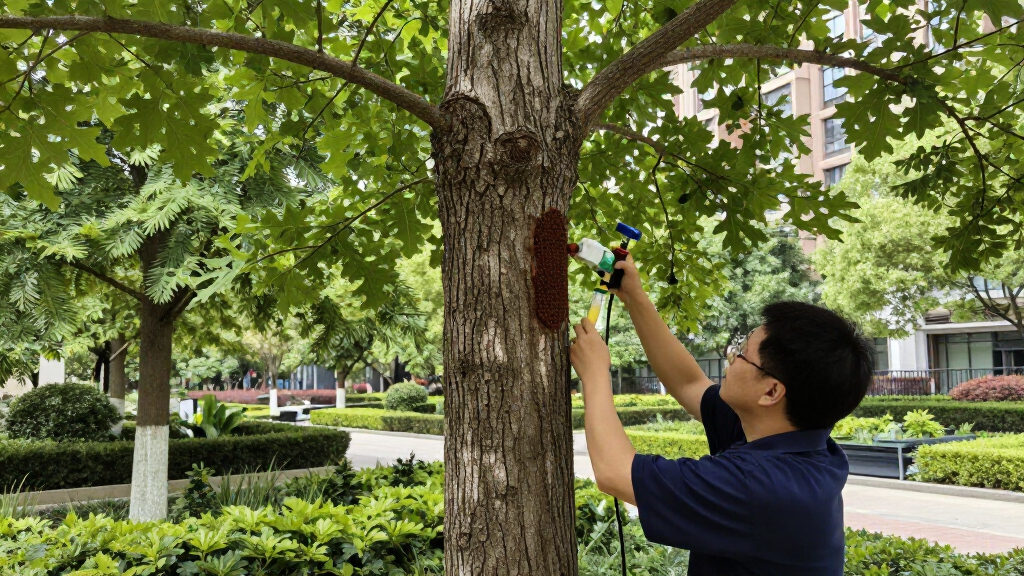
The Beijing Municipal Garden Bureau has successfully applied micro-pore precision injection technology directly into the trunks of high-standing trees infested with American white moth. This method involves creating tiny, targeted holes in the tree bark, through which pest-control agents are precisely delivered into the tree’s vascular system. The approach aims to eliminate the pests from within, reducing the need for surface spraying and minimizing environmental impact.
According to official sources, this technique has shown promising results in pilot areas, with a marked decrease in moth populations and minimal damage to the trees themselves. The method is particularly suited for tall, mature trees where traditional spraying methods struggle to reach effectively. The initiative was launched in response to increasing concerns over pest-related damage to urban greenery and the limitations of conventional control methods.
Experts involved in the project emphasize that the micro-pore injection offers a targeted, environmentally friendly alternative that can be scaled across the city’s green spaces. The approach is also expected to reduce pesticide use, lower costs, and improve the safety of urban tree management for both workers and residents.
Innovative Pest Control for Urban Trees
This development matters because it represents a technological breakthrough in urban pest management, especially for large trees that are difficult to treat with traditional methods. The successful application of micro-pore trunk injection could serve as a model for other cities facing similar pest challenges, potentially transforming urban forestry practices nationwide. It also highlights a move toward more sustainable, targeted pest control solutions that minimize environmental impact and improve the health of urban ecosystems.
Furthermore, controlling the American white moth is crucial because its larvae can cause significant damage to tree foliage, weakening trees and affecting urban aesthetics and air quality. Effective pest management preserves urban greenery, which is vital for environmental and public health.
micro-pore trunk injection pest control kit
As an affiliate, we earn on qualifying purchases.
As an affiliate, we earn on qualifying purchases.
Background on White Moth Infestation and Control Challenges
The American white moth, an invasive pest species, has increasingly threatened urban trees in Beijing and other cities. Its larvae feed on the leaves of various tree species, causing defoliation and weakening the trees’ overall health. Traditional control methods, such as surface spraying of pesticides, have proven less effective for tall, mature trees due to difficulty in reaching the pests and concerns over pesticide drift and environmental safety.
In recent years, urban forestry authorities have sought innovative solutions to address these challenges, including biological controls and targeted chemical treatments. The micro-pore trunk injection technique is among the latest advances, developed to deliver pesticides directly into the tree’s vascular system, thus bypassing surface barriers and reducing chemical usage. The initiative aligns with broader efforts in Beijing to modernize urban green space management and enhance pest control efficacy.
While this method has shown promising results in preliminary trials, it remains relatively new, and authorities continue to monitor its long-term effectiveness and safety.
Remaining Questions About Long-Term Effectiveness
It is still unclear how long the effects of the micro-pore injection will last and whether repeated treatments will be necessary. Authorities have not yet released comprehensive data on the long-term outcomes or potential impacts on tree health beyond initial results. Further monitoring and research are needed to confirm the method’s sustainability and safety over multiple seasons.
Scaling Up and Monitoring Future Outcomes
The Beijing Garden Bureau plans to expand the use of micro-pore trunk injection across more urban areas affected by white moths. Ongoing monitoring will assess the long-term efficacy, environmental safety, and cost-effectiveness of the approach. Additionally, authorities may refine the technique based on feedback from pilot projects and scientific evaluations, aiming to establish it as a standard pest control practice for tall urban trees.
Key Questions
How does the micro-pore trunk injection work?
The method involves creating tiny holes in the tree bark, through which pesticides are injected directly into the tree’s vascular system, targeting pests from within.
Is this method safe for the environment?
Yes, because it reduces pesticide use and minimizes chemical runoff, making it a more environmentally friendly alternative to surface spraying.
Will the treatment need to be repeated?
It is currently unclear how long the effects last, and repeated treatments may be necessary, depending on pest resurgence and tree health.
Can this method be used on all types of trees?
It is primarily suited for tall, mature trees where traditional methods are less effective, but its applicability to other tree types is still being evaluated.
What are the next steps for this pest control approach?
Authorities plan to expand its use, monitor outcomes over time, and refine the technique based on ongoing research and field data.
Source: local