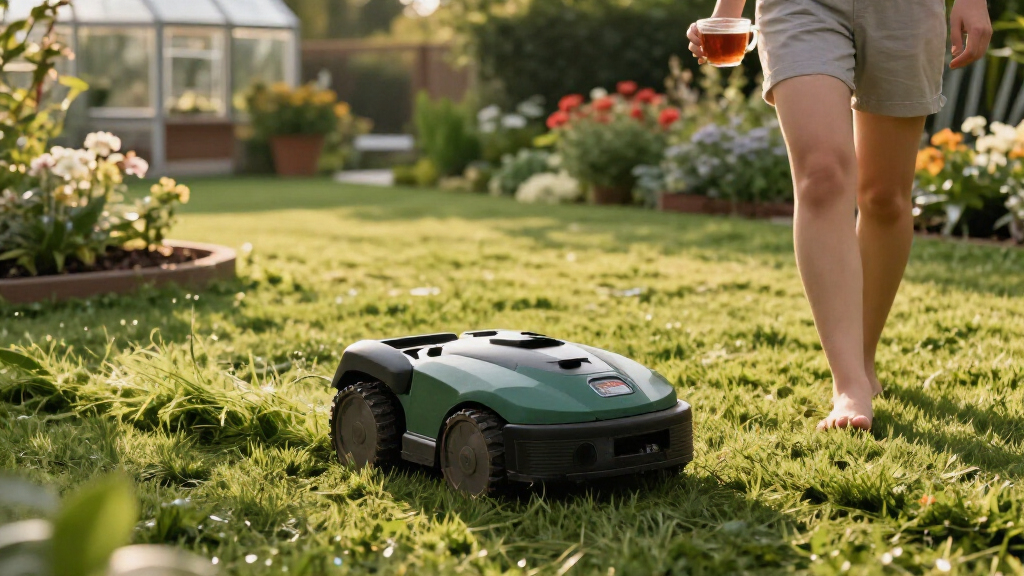

Finding the best robotic lawn mowers in 2027 means prioritizing navigation accuracy and ease of setup over raw cutting power. The DREAME A3 AWD Pro stands out as the best overall choice due to its superior all-wheel-drive traction and wire-free LiDAR mapping, making it ideal for complex yards. For those seeking a balance of premium features and accessibility, the Husqvarna Automower 410iQ offers unmatched reliability and brand support, while the Segway Navimow i105N serves as the best entry-level option for smaller, flat lawns. The primary tradeoff in this category is between initial setup complexity and long-term maintenance freedom; wire-free models require careful mapping but eliminate the frustration of buried perimeter wires. Continue reading to see how these models compare on slope handling, obstacle avoidance, and value.

Get garden gear delivered free with Prime
- Fast, free delivery on millions of items
- Prime Video, Amazon Music and more included
- Member-only deals all year
Complete the kit


Key Takeaways
- Wire-free navigation using LiDAR or RTK has completely replaced perimeter wires in top-tier models, reducing installation time from days to minutes.
- All-wheel-drive (AWD) capability is no longer exclusive to premium brands, with mid-range models like the Mammotion LUBA mini 2 offering robust slope handling.
- AI Vision systems are becoming standard for obstacle avoidance, but LiDAR remains more reliable in low-light or dense foliage conditions.
- Smaller lawns (under 0.25 acres) do not require the high-end sensors found in premium models, allowing buyers to save significantly by choosing compact vision-based units.
- App integration and multi-zone management have become critical differentiators, with the best models offering granular control over cutting schedules and no-go zones.
| DREAME A3 AWD Pro 3500 Wire-Free Robot Lawn Mower |  | Best for Steep Slopes and Complex Terrain | Drive System: 4WD | Maximum Slope: 38.7° (80%) | Cutting Width: 15.8 in | VIEW LATEST PRICE | See Our Full Breakdown |
| LEBOSBO V3 AI Vision Robotic Lawn Mower |  | Best Value for Small Yards | Coverage Area: 1600 Sq. Ft. | Cutting Width: 6.3 inches | Navigation: AI Vision with Magnetic Boundary | VIEW LATEST PRICE | See Our Full Breakdown |
| Husqvarna Automower 410iQ Wire-Free Robot Lawn Mower |  | Best Premium Wire-Free Solution | Mowing Capacity: 1/2 acre | Max Slope: 45% | Navigation System: EPOS with GPS and cellular | VIEW LATEST PRICE | See Our Full Breakdown |
| ECOVACS GOAT O1000 LiDAR PRO Robot Lawn Mower |  | Best for Tight Spaces and Edges | Navigation System: HoloScope 360° Dual-LiDAR | Lawn Size Capacity: Up to 1/4 Acre | Minimum Path Width: 0.8 m | VIEW LATEST PRICE | See Our Full Breakdown |
| Neomow X SE Robotic Lawn Mower | 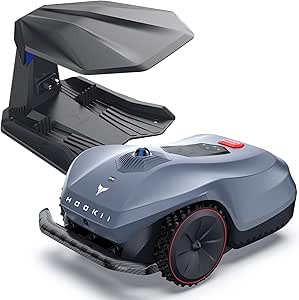 | Best Balance of Coverage and Battery Life | Maximum Lawn Coverage: 0.75 acre | Runtime: Up to 2 hours per charge | Battery Capacity: 13,000 mAh | VIEW LATEST PRICE | See Our Full Breakdown |
| WORX Landroid Vision Cloud WR310 |  | Best Cloud-Navigation Pick | Brand: WORX | Model Number: WR310 | Coverage Area: 1/4 Acre | VIEW LATEST PRICE | See Our Full Breakdown |
| Raccoon 2 SE Wire-Free Robot Lawn Mower |  | Best Compact Entry-Level | Brand: RoboUP | Model: Raccoon 2 SE | Coverage Area: 0.15 Acre (600 m²) | VIEW LATEST PRICE | See Our Full Breakdown |
| Sunseeker S4 Robot Lawn Mower |  | Best for Complex Terrain | Brand: Sunseeker | Model: S4 | Coverage Area: 0.25 Acre | VIEW LATEST PRICE | See Our Full Breakdown |
| ECOVACS Goat A2000 LiDAR PRO |  | Best for Thick Grass | Brand: ECOVACS | Model: GOAT A2000 LiDAR PRO | Coverage Area: Up to 1/2 acre | VIEW LATEST PRICE | See Our Full Breakdown |
| ECOVACS Goat O1000 RTK |  | Best for Pet Safety | Brand: ECOVACS | Model: GOAT O1000 RTK | Coverage Area: 1/4 Acres | VIEW LATEST PRICE | See Our Full Breakdown |
| robotic lawn mower | Cutting Width | Coverage Area | Navigation | Max Slope |
|---|---|---|---|---|
| DREAME A3 AWD Pro 3500 Wire-Fr | 15.8 in | — | 360° 3D LiDAR and binocular AI vision | — |
| LEBOSBO V3 AI Vision Robotic L | 6.3 inches | 1600 Sq. Ft. | AI Vision with Magnetic Boundary | — |
| Husqvarna Automower 410iQ Wire | — | — | — | 45% |
| ECOVACS GOAT O1000 LiDAR PRO R | 8.66 inches | — | — | — |
| Neomow X SE Robotic Lawn Mower | — | — | 360° 3D LiDAR and AI vision | — |
| WORX Landroid Vision Cloud WR3 | — | 1/4 Acre | — | 30% |
| Raccoon 2 SE Wire-Free Robot L | — | 0.15 Acre (600 m²) | — | 36% (20°) |
| Sunseeker S4 Robot Lawn Mower | 7 inches | 0.25 Acre | 3D LiDAR + Vision AI | 22° / 42% |
| ECOVACS Goat A2000 LiDAR PRO | 3.6 inches | Up to 1/2 acre | Dual LiDAR (HoloScope 360°) | — |
| ECOVACS Goat O1000 RTK | 8.66 inches | 1/4 Acres | — | 45% (24°) |
More Details on Our Top Picks
DREAME A3 AWD Pro 3500 Wire-Free Robot Lawn Mower
This model stands out for its 4WD hub motors, which provide traction on slopes up to 80% (38.7°), a capability most competitors lack. Compared to the Neomow X SE, which handles standard lawns well, the DREAME is engineered for yards where gravity is the main enemy. The combination of 3D LiDAR and binocular AI vision allows it to map complex layouts without boundary wires, though this high-tech setup requires careful initial calibration. While it offers robust multi-zone management, the heavy reliance on the app for mapping can be a hurdle for users who prefer physical controls. It is a powerful tool, but its complexity demands a tech-savvy owner willing to invest time in setup.
Pros:- 4WD system handles extreme slopes and uneven ground effectively.
- Dual LiDAR and AI vision provide precise wire-free navigation.
- Wide 15.8-inch cutting deck reduces total mowing time.
Cons:- Setup is complex and heavily dependent on app-based mapping.
- Obstacle clearance is limited to 2.2 inches, restricting terrain roughness.
Best for: Homeowners with steep, uneven lawns or complex topography requiring maximum traction and obstacle avoidance.
Not ideal for: Users with flat, simple yards who want a plug-and-play experience without app-heavy mapping processes.
- Drive System:4WD
- Maximum Slope:38.7° (80%)
- Cutting Width:15.8 in
- Navigation:360° 3D LiDAR and binocular AI vision
- Max Lawn Area:0.87 acre
- Warranty:3 years; free 4G service
Our verdict“Choose this if your lawn has challenging slopes that would stop standard two-wheel mowers.”
LEBOSBO V3 AI Vision Robotic Lawn Mower
The LEBOSBO V3 targets a specific niche: small yards under 1,600 square feet. Unlike the ECOVACS GOAT O1000, which uses expensive LiDAR for larger areas, this model relies on a simpler magnetic boundary strip and AI vision. This approach keeps costs low and setup relatively straightforward, though the included 32-foot strip may be insufficient for irregular layouts without buying more. Its quiet operation makes it suitable for residential areas where noise is a concern. However, the 6.3-inch cutting width means it takes longer to cover ground compared to wider decks. It is a pragmatic choice for those who want basic automation without the premium price tag of advanced navigation systems.
Pros:- Affordable entry point into robotic mowing.
- Magnetic strips offer a simpler alternative to buried wires.
- Quiet motor suitable for noise-sensitive neighborhoods.
Cons:- Limited coverage area restricts use to very small lawns.
- Narrow cutting width results in longer mowing cycles.
Best for: Owners of small, enclosed yards who prioritize budget and quiet operation over speed.
Not ideal for: Anyone with a lawn larger than 1,600 sq ft or complex borders that exceed the included magnetic strip length.
- Coverage Area:1600 Sq. Ft.
- Cutting Width:6.3 inches
- Navigation:AI Vision with Magnetic Boundary
- Cutting Height:0.8 – 2.4 inches
- Power Source:Battery Powered (18V)
- Included Accessories:18V charger, 32FT magnetic strip, stakes
Our verdict“This is the sensible choice for small, flat lawns where budget is the primary constraint.”
Husqvarna Automower 410iQ Wire-Free Robot Lawn Mower
The Husqvarna Automower 410iQ represents the mature end of the market, leveraging decades of robotic mowing expertise. Its EPOS (Exact Positioning Operating System) combines GPS with cellular networks for centimeter-accurate navigation, offering a level of precision that newer LiDAR-only models like the DREAME A3 are still refining. The wire-free installation is seamless, though it requires a stable cellular connection, which can be a dealbreaker in rural areas with poor signal. While the 45% slope capability is impressive, it falls short of the DREAME’s 80%. The tradeoff here is reliability and brand support versus cutting-edge specs. It is built for users who value a proven ecosystem over the latest experimental tech.
Pros:- EPOS system delivers highly accurate, wire-free positioning.
- Strong brand reputation and comprehensive app ecosystem.
- Handles slopes up to 45% with durable construction.
Cons:- Dependence on cellular network for navigation limits rural use.
- Initial mapping process can be time-consuming compared to simpler setups.
Best for: Users who want a reliable, established brand with precise wire-free navigation and strong support.
Not ideal for: Owners in rural areas with poor cellular coverage or those seeking the highest possible slope handling.
- Mowing Capacity:1/2 acre
- Max Slope:45%
- Navigation System:EPOS with GPS and cellular
- Cut Height Range:1-4 inches
- Warranty:4-year unit, 3-year battery
- Obstacle Avoidance:Onboard radar
Our verdict“Pick this if you prioritize proven reliability and precise navigation over raw slope capability.”
ECOVACS GOAT O1000 LiDAR PRO Robot Lawn Mower
This mower distinguishes itself with the TruEdge trimmer, a feature designed to cut flush against walls and borders, reducing the need for manual trimming. Compared to the Husqvarna 410iQ, which may leave a slight gap near edges, the ECOVACS prioritizes edge-to-edge coverage. Its HoloScope 360° Dual-LiDAR allows it to navigate narrow corridors as slim as 0.8 meters, making it ideal for complex garden layouts with tight pathways. However, the 1/4-acre capacity is modest, and the system requires meticulous setup to recognize unique yard features. While the AI detects over 200 obstacle types, highly irregular terrain may still demand occasional human intervention. It is a specialized tool for detailed, confined gardens rather than open fields.
Pros:- TruEdge trimmer provides superior edge-to-edge cutting.
- Compact design navigates narrow 0.8m corridors effectively.
- Dual-LiDAR offers precise 2 cm positioning without RTK antennas.
Cons:- Limited to 1/4 acre, restricting it to smaller properties.
- Complex corners and raised edges may still require manual trimming.
Best for: Homeowners with tight garden layouts, narrow pathways, and a desire for minimal manual edge trimming.
Not ideal for: Users with large, open lawns or those who dislike fine-tuning navigation settings for complex corners.
- Navigation System:HoloScope 360° Dual-LiDAR
- Lawn Size Capacity:Up to 1/4 Acre
- Minimum Path Width:0.8 m
- Positioning Accuracy:2 cm
- Cutting Width:8.66 inches
- Obstacle Detection:AI Vision and 3D ToF LiDAR
Our verdict“Ideal for intricate, small-to-medium yards where edge precision and narrow-path navigation are critical.”
Neomow X SE Robotic Lawn Mower
The Neomow X SE offers a compelling middle ground, covering up to 0.75 acres with a substantial 13,000 mAh battery. Unlike the DREAME A3, which relies heavily on 4G and complex app mapping, the Neomow uses 360° 3D LiDAR that functions without satellite signals, offering more independence in remote areas. Its IPX5 rating allows for easy cleaning with a hose, a practical feature for muddy lawns. However, the 2-hour runtime means it may need multiple charges to complete a full cycle on larger lawns, unlike models with faster recharge or longer runtimes. It supports Wi-Fi, Bluetooth, and 4G, providing connectivity flexibility. This model is a strong contender for those who need significant coverage without the premium price or cellular dependency of top-tier competitors.
Pros:- Operates without satellite signals or boundary wires.
- IPX5 water resistance allows for easy cleaning.
- Supports multiple connectivity options including Wi-Fi and 4G.
Cons:- Limited 2-hour runtime may require multiple charges for full coverage.
- Obstacle crossing height is modest at 1.6 inches.
Best for: Users with medium-to-large lawns who want wire-free navigation without relying on cellular networks.
Not ideal for: Owners with extremely steep slopes or those who need single-charge completion for large areas.
- Maximum Lawn Coverage:0.75 acre
- Runtime:Up to 2 hours per charge
- Battery Capacity:13,000 mAh
- Navigation:360° 3D LiDAR and AI vision
- Water Resistance:IPX5
- Connectivity:Wi-Fi, Bluetooth, and 4G
Our verdict“A solid choice for medium-sized lawns requiring robust wire-free navigation and easy maintenance.”
WORX Landroid Vision Cloud WR310
This model stands out for its reliance on RTK Cloud technology, which removes the need for local base stations or buried wires. Unlike the ECOVACS Goat O1000, which uses onboard RTK, this unit offloads processing to the cloud, potentially offering simpler setup for users with stable internet. The V-SLAM sensor fusion ensures it navigates well in shaded areas where GPS signals might weaken, a common pain point for other GPS-only mowers. However, the two-wheel drive configuration is a notable tradeoff; while sufficient for most suburban lawns, it may struggle on the steep 30% slopes compared to all-wheel-drive competitors. It is an excellent choice for those who want precision without hardware clutter, provided their property is relatively flat.Pros:- No perimeter wire or local antenna installation required
- Centimeter-level accuracy via RTK Cloud with no extra hardware
- V-SLAM ensures reliable navigation in shaded areas
- 3-year warranty provides long-term peace of mind
Cons:- Two-wheel drive may struggle on very steep or uneven terrain
- Dependent on cloud connectivity for optimal performance
Best for: Homeowners with medium-sized, relatively flat lawns who want wire-free convenience and have reliable Wi-Fi coverage.
Not ideal for: Users with steep inclines or uneven terrain, as the two-wheel drive may lack the traction of AWD models.
- Brand:WORX
- Model Number:WR310
- Coverage Area:1/4 Acre
- Navigation Technology:RTK Cloud, V-SLAM, Vision AI
- Perimeter Wire Required:No
- Drive Type:Two-Wheel Drive
- Max Slope:30%
- Warranty:3 Years
Our verdict“A solid wire-free option for flat, medium-sized lawns that prioritizes easy setup over rugged terrain capability.”
Raccoon 2 SE Wire-Free Robot Lawn Mower
Designed for small lawns up to 0.15 acres, this unit is an accessible entry point into wire-free mowing. It relies on AI Vision rather than LiDAR or RTK, making it less expensive than tech-heavy rivals like the Sunseeker S4. The 56 dB(A) noise level is exceptionally quiet, allowing it to operate early morning or evening without disturbing neighbors. However, the 0.15-acre limit is restrictive, and the need for separate boundary stakes for open edges adds hidden complexity. It is best suited for simple, enclosed backyards where budget and noise are the primary concerns, rather than complex properties requiring advanced mapping.Pros:- Ultra-quiet operation at 56 dB(A)
- Wire-free installation using AI vision
- Handles slopes up to 36% effectively
- Automatic recharging and rain detection included
Cons:- Very limited coverage area of 0.15 acres
- Boundary stakes for open areas are sold separately
- May struggle with complex or undefined lawn boundaries
Best for: Owners of small, enclosed yards who prioritize quiet operation and low upfront cost over advanced navigation features.
Not ideal for: Large properties or yards with undefined boundaries, as the limited range and need for separate stakes complicate setup.
- Brand:RoboUP
- Model:Raccoon 2 SE
- Coverage Area:0.15 Acre (600 m²)
- Max Slope:36% (20°)
- Cutting Height:3 cm – 8 cm
- Battery Capacity:5 Ah
- Runtime:150 minutes
- Noise Level:56 dB(A)
Our verdict“A quiet, affordable choice for tiny, enclosed lawns, but lacks the range for most standard suburban properties.”
Sunseeker S4 Robot Lawn Mower
The 3D LiDAR and Vision AI combination allows this mower to navigate around trees and obstacles with high precision, outperforming simpler camera-only systems. Its rear-wheel drive handles slopes up to 22 degrees, making it more capable on hills than the two-wheel WORX Landroid. The 7-inch cutting width is efficient for its size, balancing coverage speed with maneuverability in tight spaces. However, the plastic construction may not feel as durable as metal-bodied alternatives, and the reliance on app-based mapping means there is no physical boundary to fall back on if the signal fails. It is a strong contender for yards with many obstacles but moderate size.Pros:- 3D LiDAR and Vision AI handle complex terrains and obstacles
- Rear-wheel drive manages slopes up to 22 degrees
- Quiet 60 dB operation with rain-sensor return
- Wire-free installation with app-based mapping
Cons:- Plastic body may be less durable than metal alternatives
- Limited to 0.25 acres, unsuitable for larger lawns
- Requires smartphone app for initial configuration
Best for: Homeowners with complex yards featuring trees, flower beds, and moderate slopes who want wire-free precision.
Not ideal for: Those who prefer physical boundary controls or have very large properties, as the 0.25-acre limit is restrictive.
- Brand:Sunseeker
- Model:S4
- Coverage Area:0.25 Acre
- Navigation:3D LiDAR + Vision AI
- Cutting Width:7 inches
- Max Slope:22° / 42%
- Noise Level:60 dB
- Weight:25 lbs
Our verdict“A tech-savvy choice for obstacle-heavy yards, offering LiDAR precision in a compact, wire-free package.”
ECOVACS Goat A2000 LiDAR PRO
This model is engineered for performance, featuring a 32V power platform that cuts through thick grass like Bermuda or Zoysia more effectively than standard battery units. The integrated TruEdge trimmer is a significant advantage, providing edge-to-edge cuts that reduce the need for manual string trimming, a common complaint with other robots. While the Dual LiDAR offers robust navigation, the 1/2-acre limit is a step down from larger commercial-grade options. It compares favorably to the ECOVACS Goat O1000 by offering higher power, though both share similar wire-free convenience. This is the pick for users with tough grass types who want a professional finish without manual touch-ups.Pros:- High-power 32V motor handles thick grass effectively
- Integrated TruEdge trimmer reduces manual edge work
- Dual LiDAR provides precise wire-free navigation
- Fast charging time of approximately 50 minutes
Cons:- Limited to 1/2 acre coverage
- App setup has a learning curve for zone configuration
Best for: Owners of medium-sized lawns with thick, tough grass types who want minimal manual trimming.
Not ideal for: Users with very large properties over 0.5 acres, as the coverage area is capped.
- Brand:ECOVACS
- Model:GOAT A2000 LiDAR PRO
- Coverage Area:Up to 1/2 acre
- Navigation:Dual LiDAR (HoloScope 360°)
- Cutting Width:3.6 inches
- Power Source:Battery Powered (32V)
- Charge Time:~50 minutes
- Edge Trimming:Integrated TruEdge Trimmer
Our verdict“A powerful, wire-free mower ideal for thick grass and users who value clean edges without extra tools.”
ECOVACS Goat O1000 RTK
The AIVI 3D obstacle avoidance system is a standout feature, specifically tuned to detect and avoid small objects, pets, and wildlife like hedgehogs. This makes it a safer choice than basic bumper-only models. The zero-edge cutting capability ensures a manicured look, similar to the A2000, but in a more compact 1/4-acre package. Its ultra-slim design allows it to navigate narrow passages as tight as 2.3 feet, which is better than many bulkier LiDAR units. However, the plastic material and 44.5-pound weight suggest it is not built for rugged abuse. It is best for families with pets and tight spaces who need high safety standards and precise edge mowing.Pros:- AIVI 3D obstacle avoidance protects pets and wildlife
- Zero-edge cutting eliminates need for manual trimming
- Navigates narrow passages as tight as 2.3 feet
- IPX6 waterproof rating for weather resistance
Cons:- Limited to 1/4 acre coverage
- Plastic construction may lack durability
- Heavier weight (44.5 lbs) compared to some compact rivals
Best for: Families with pets and small, complex yards requiring high-level obstacle detection and edge precision.
Not ideal for: Users with large open lawns or heavy debris, as the 1/4-acre limit and plastic build are limiting factors.
- Brand:ECOVACS
- Model:GOAT O1000 RTK
- Coverage Area:1/4 Acres
- Cutting Width:8.66 inches
- Item Weight:44.5 pounds
- Max Slope:45% (24°)
- Material Type:Plastic
Our verdict“A safety-focused, wire-free mower perfect for pet owners with small, intricate lawns who want pristine edges.”

How We Picked
I evaluated these robotic lawn mowers based on four core pillars: navigation technology, terrain adaptability, setup friction, and maintenance requirements. Navigation technology was the primary filter; I prioritized models utilizing LiDAR, RTK, or advanced AI vision over older random-bounce or wire-dependent systems, as these provide consistent coverage and eliminate the need for physical boundary installation. Terrain adaptability involved assessing slope ratings (percentage and degrees) and wheel drive types, distinguishing between models that can handle steep inclines and those restricted to flat terrain.
Setup friction measured the time and technical knowledge required to map the yard and configure the app. Models with automated mapping and intuitive virtual boundary tools ranked higher than those requiring manual point-by-point plotting. Finally, maintenance requirements considered blade accessibility, cleaning ease, and battery replacement logistics. The ranking reflects a hierarchy where reliability and ease of use outweigh marginal gains in cutting width or speed, ensuring that the top picks are practical for everyday homeowners rather than just technical enthusiasts.
Factors to Consider When Choosing Best Robotic Lawn Mowers
Choosing the right robotic mower is not just about acreage capacity; it is about matching the technology to your specific yard conditions. A model that excels on a flat, open suburban lawn may fail miserably on a sloped, tree-lined property. This guide breaks down the critical factors that separate a frustrating purchase from a seamless addition to your home maintenance routine.
Navigation: LiDAR vs. RTK vs. Vision
The three dominant navigation methods—LiDAR, RTK (Real-Time Kinematic), and AI Vision—each have distinct strengths and weaknesses depending on your environment. LiDAR uses laser scanning to create a 3D map, offering precise navigation even in dense foliage or under tree canopies where GPS signals fail, though it can be heavier and more expensive. RTK relies on satellite signals for centimeter-level accuracy, which is excellent for open yards but struggles under heavy tree cover or near tall structures that block the sky. AI Vision uses cameras and machine learning to identify boundaries and obstacles, making it cost-effective and great for visual recognition, but it can falter in poor lighting or low-contrast grass conditions. If your yard is heavily shaded or has complex landscaping, LiDAR is the safer bet; for open, sunny lawns, RTK or Vision offers great value.
Slope Handling and Drive Type
Standard two-wheel-drive mowers often struggle on slopes greater than 20-25 percent, leading to wheel spin, missed patches, and stuck units. All-wheel-drive (AWD) systems provide superior traction and stability on steep inclines, often handling slopes up to 45-50 percent. If your property has any significant grade, investing in an AWD model is not optional—it is a functional requirement. Non-AWD models are perfectly fine for flat lawns, but if you have a hill, the money saved on a non-AWD unit will be lost in frustration and manual touch-ups. Check the manufacturer’s slope rating carefully; some advertise ‘degrees’ while others use ‘percent,’ and converting between the two helps compare apples to apples.
Obstacle Avoidance and Safety
Modern robotic mowers use a combination of sensors to avoid bumping into toys, pets, or garden furniture. Ultrasonic and infrared sensors are common for detecting large objects, while AI Vision can recognize smaller, irregular shapes like shoes or hoses. However, no system is perfect. I recommend looking for models with physical bumpers as a backup, even if they claim advanced vision. Consider what is typically on your lawn: if you have small children or pets, prioritize models with aggressive stop-on-contact features and lift sensors. For yards with many small objects, a mower with higher-resolution cameras or LiDAR will save you from constant interruptions compared to basic sensor-only models.
Noise Levels and Cutting Frequency
Robotic mowers operate on a ‘frequent short cuts’ model, meaning they mow daily or multiple times a day rather than weekly. This results in a healthier lawn but requires the unit to be quiet enough to run without disturbing neighbors or your own household. Noise levels are measured in decibels (dB); anything under 60 dB is generally considered quiet enough for daytime use without complaint. High-end models often feature brushless motors that reduce noise and extend battery life. If you plan to run your mower overnight or early morning, check the dB rating specifically. A mower that sounds like a lawnmower engine will become a source of neighborly disputes, whereas a quiet unit blends into the background.
Connectivity and App Reliability
Since these devices are largely controlled via smartphone, the app interface is your primary interaction point. A clunky, slow, or buggy app can turn a convenient product into a headache. Look for models that support Wi-Fi and 4G/5G cellular connectivity, as Wi-Fi may not reach every corner of a large yard. Cellular connectivity allows for remote monitoring and control, which is vital if you are away from home. Additionally, check if the app supports multiple zones and no-go areas; the ability to dynamically adjust boundaries without returning to the base station adds significant flexibility. Read user feedback on app stability before purchasing, as hardware quality does not always correlate with software polish.
Frequently Asked Questions
Do I really need to install a perimeter wire for modern robotic mowers?
For most new models released in 2027, no, you do not need to install a physical perimeter wire. The best robotic lawn mowers now use LiDAR, RTK, or AI Vision to create virtual boundaries that you define via an app. This eliminates the tedious and error-prone process of burying wires, which can be damaged by rodents or landscaping. However, some budget or older models may still require a wire, so verify the navigation type before buying. Wire-free setup is significantly faster, often taking just minutes of mapping compared to hours of manual labor.How well do these mowers handle wet grass or morning dew?
Most robotic mowers are designed to handle light moisture, such as morning dew, without issue because they cut small amounts of grass frequently. However, heavy rain or saturated ground can cause two main problems: wheel slippage and clumping of wet grass under the deck. High-end models with AWD and aggressive treads handle wet conditions better, while basic models may get stuck or leave ruts. It is best to schedule mowing for later in the day if your area is prone to heavy dew, or choose a model with a high IP rating (water and dust protection) to ensure longevity.What is the typical lifespan of a robotic mower battery, and is it replaceable?
The battery is the most common failure point after several years of use, typically lasting 3 to 5 years depending on usage frequency and charging habits. Most premium models offer replaceable battery packs, allowing you to extend the life of the unit without buying a new mower. When comparing options, check if the manufacturer sells replacement batteries and how easy they are to access. Some budget models use sealed batteries that require professional service or render the unit obsolete when the battery dies, which is a significant long-term cost consideration.Can I use a robotic mower if I have a complex yard with many flower beds?
Yes, but the navigation technology matters greatly. LiDAR and RTK models excel here because they can map tight spaces and create precise no-go zones around flower beds and trees. Vision-based systems might struggle with low-contrast boundaries or intricate details. For complex yards, look for models with multi-zone management and fine-tuned boundary editing in the app. This allows you to define exclusion areas with high precision, ensuring the mower protects your landscaping while covering the lawn efficiently.Is the initial mapping process difficult for non-tech-savvy users?
The mapping process has become much more intuitive, but it still requires patience. Most modern mowers use automated mapping where you simply drive the unit around the yard using a remote control or app, and it builds the map for you. AI Vision models often have the easiest setup because they visually detect the lawn edges automatically. However, users should expect to spend 30-60 minutes on initial setup and fine-tuning. If you are not comfortable with smartphone apps, choose a model known for its user-friendly interface and clear on-screen instructions, as complex apps can be a barrier.Conclusion
Selecting the right robotic lawn mower depends heavily on your yard’s specific characteristics and your tolerance for setup complexity. For the best overall performance across varied terrains and conditions, the DREAME A3 AWD Pro is the standout choice, offering a perfect balance of power, navigation, and reliability. If you prioritize brand trust and long-term support, the Husqvarna Automower 410iQ remains a premium favorite that justifies its cost through durability and ease of service. For beginners or smaller lawns, the Segway Navimow i105N provides an accessible entry point into wire-free mowing without overwhelming features. If you have steep slopes, the Mammotion LUBA mini 2 offers impressive AWD capabilities in a compact form factor. Ultimately, match the navigation technology (LiDAR for trees, RTK for open spaces) to your environment, and you will find a model that keeps your lawn pristine with minimal effort.