
Greenhouse heater thermostats range from plug-in controllers that regulate a separate heater to all-in-one heaters with built-in temperature controls. My best overall pick is the INKBIRD 15A Plug-In Programmable Temperature Controller, a flexible choice for growers who already own a compatible heater; the Inkbird ITC-308 stands out for its dual-outlet control, while the VIVOSUN AeroFlux 700W suits smaller grow spaces needing app-based monitoring. The main tradeoffs are separate-controller flexibility versus all-in-one simplicity, and advanced remote features versus straightforward local controls. Heater wattage, controller load limits, sensor placement, and greenhouse size all affect the choice. Read on for the full comparison and guidance on matching a thermostat setup to your space.

Get garden gear delivered free with Prime
- Fast, free delivery on millions of items
- Prime Video, Amazon Music and more included
- Member-only deals all year
Complete the kit


Key Takeaways
Separate controllers offer the most setup flexibility. The INKBIRD 15A Plug-In and Inkbird ITC-308 can control compatible heaters you already own, while their usefulness depends on correct wiring, load limits, and outlet placement.
The ITC-308 stands apart for dual-outlet control. Its heating and cooling outputs can support more varied temperature-control arrangements than a basic single-outlet controller, though it adds setup complexity.
Most all-in-one heater picks center on 1500W output. That repeated rating does not mean every unit will suit every greenhouse; insulation, air leakage, and cold-weather conditions shape actual heating needs.
WiFi is a convenience, not a substitute for dependable local control. Pasapair, lesotc, and VIVOSUN offer connected features, but buyers should still check how each unit behaves if the network or app is unavailable.
Compact grow spaces have a different shortlist. The 700W VIVOSUN AeroFlux is a lower-output option than the 1500W heaters, making space and heat demand more relevant than choosing the largest wattage by default.
| INKBIRD 15A Plug-In Programmable Temperature Controller |  | Best for Flexible Probe Placement | Model: C226T15A-US | Maximum power: 1800 W | Current: 15 A | VIEW LATEST PRICE | See Our Full Breakdown |
| SmterCon Greenhouse Heater with Thermostat |  | Best Simple All-in-One Heater | Model: MGP-2 | Power: 1500 W | Heating method: Convection | VIEW LATEST PRICE | See Our Full Breakdown |
| DEWENWILS 15A Temperature Controller Outlet with VA Display |  | Best for Fine Temperature Adjustments | Model: HTCS02A | Current and maximum wattage: 15 A; 1800 W | Voltage: 120 V | VIEW LATEST PRICE | See Our Full Breakdown |
| TRUSTECH Greenhouse Heater with Digital Thermostat, 1500W |  | Best for Adjustable Heat Output | Model: PTC-1500R | Power settings: 750 W and 1500 W | Heating element: PTC ceramic | VIEW LATEST PRICE | See Our Full Breakdown |
| 1500W Greenhouse Heater with Thermostat, 2-Pack, Green |  | Best for Multi-Zone Coverage | Quantity: 2 heaters | Power modes: 1500 W high; 750 W low; 24 W fan-only | Power supply: 110 V AC / 60 Hz | VIEW LATEST PRICE | See Our Full Breakdown |
| BN-LINK Digital Reptile Thermostat Temperature Controller |  | Best Standalone Thermostat Controller | Temperature range: 40–108°F | Maximum load: 1000W, 8.3A | Voltage: 120VAC, 60Hz | VIEW LATEST PRICE | See Our Full Breakdown |
| SmterCon Greenhouse Heater with Digital Thermostat |  | Best Simple Integrated Heater | Power: 1500W | Thermostat: Digital automatic temperature control | Heating coverage: Up to 120 sq. ft. | VIEW LATEST PRICE | See Our Full Breakdown |
| ZIZIWIN 1500W Greenhouse Heater with Digital Thermostat |  | Best for Adjustable Airflow | Power: 1500W | Heating method: Convection | Coverage: Up to 120 sq. ft. | VIEW LATEST PRICE | See Our Full Breakdown |
| Pasapair 1500W WiFi Greenhouse Heater with Thermostat |  | Best Smart-Controlled Option | Power: 1500W | Heating method: PTC ceramic | Heating coverage: 215 sq. ft. | VIEW LATEST PRICE | See Our Full Breakdown |
| VEVOR 1500W Electric PTC Greenhouse Heater with Thermostat and Fan |  | Best Manual-Control Alternative | Heating element: PTC ceramic | Heat output: 1500W | Voltage: 120V | VIEW LATEST PRICE | See Our Full Breakdown |
| Buyplus 1500W Greenhouse Heater with Digital Thermostat |  | Best for Broad Temperature Adjustment | Model: BG-E2 | Heating power: 1500W | Fan-only power: 25W | VIEW LATEST PRICE | See Our Full Breakdown |
| Inkbird ITC-308 Digital Temperature Controller Thermostat |  | Best Standalone Controller for Heating and Cooling | Model: ITC-308 | Control type: Heating and cooling with separate relays | Maximum output load: 1100W | VIEW LATEST PRICE | See Our Full Breakdown |
| VIVOSUN AeroFlux 700W PTC Grow Tent Heater with Thermostat, App Control, and VPD Monitoring |  | Best Smart Pick for Compact Grow Tents | Model number: VSE-ATW70-AU-FBM | Part number: VSE-ATW70-EU | Heating power: 700W | VIEW LATEST PRICE | See Our Full Breakdown |
| lesotc 1500W Greenhouse Heater with Thermostat and WiFi App Control |  | Best for Remote Greenhouse Monitoring | Model: G2308 | Heating element: PTC ceramic | Heat output: 1500W | VIEW LATEST PRICE | See Our Full Breakdown |
| VEVOR 1500W Greenhouse Heater with Thermostat |  | Best Value for Straightforward Portable Heating | Model: BG-E2A-15 | Power: 1500W | Voltage and current: 120V; 12.5A | VIEW LATEST PRICE | See Our Full Breakdown |
More Details on Our Top Picks
INKBIRD 15A Plug-In Programmable Temperature Controller
The INKBIRD is a controller for growers who already own a heater and want to place the temperature sensor where their plants actually are. Its IP67 waterproof probe can sit in soil or water, giving it more placement flexibility than the DEWENWILS outlet controller, whose listed details do not specify a waterproof probe. It also switches between heating and cooling, with cycle and countdown timers for setups that need more than simple on/off temperature control.
The backlit LCD and adjustable high- and low-temperature alarms make status checks easier, but this is not a heater: you supply the heating or cooling device and manage the wiring at the outlet. The biggest concern is the conflicting voltage information—120 Vac in the description and 240 V in the specifications. I would verify compatibility before connecting greenhouse equipment.
Pros:- Controls both heating and cooling with adjustable start and stop temperatures
- IP67 probe supports soil or submerged-water placement
- Cycle and countdown timer modes add scheduling flexibility
- Backlit LCD and adjustable temperature alarms aid monitoring
Cons:- Voltage data conflicts between 120 Vac and 240 V, so compatibility needs confirmation
- Does not include a heater or cooling device
- Push-button controls may be less convenient for frequent setting changes than app control
Best for: Growers who already have compatible heating or cooling equipment and need a waterproof sensor they can position in soil or water.
Not ideal for: Buyers who want an all-in-one greenhouse heater or cannot confirm the controller’s correct operating voltage before use.
- Model:C226T15A-US
- Maximum power:1800 W
- Current:15 A
- Voltage:120 Vac in description; 240 V in specifications
- Temperature range:-40°F to 212°F
- Probe:IP67 waterproof temperature probe
- Timer range:0 to 99 hours 59 minutes
- Display and controls:Backlit LCD; push-button
Our verdict“Choose the INKBIRD when probe placement and heating-or-cooling control matter more than an included heater, but confirm its voltage first.”
SmterCon Greenhouse Heater with Thermostat
Unlike the INKBIRD and DEWENWILS, which regulate equipment you provide, the SmterCon pairs a 1500W convection heater with its own digital thermostat. That makes it a straightforward choice for a small greenhouse where the goal is automatic heat without assembling a separate controller-and-heater setup. Its stated coverage reaches up to 120 sq. ft., and adjustable airflow can help move warmth through the space rather than leaving it concentrated near the unit.
The tradeoff is limited reach: the TRUSTECH heater is specified for up to 160 sq. ft. and offers multiple heat settings, while the SmterCon’s listed details focus on one 1500W heater and automatic temperature control. Its floor placement also takes up usable space, and no operating noise level is provided. I would reserve it for a modest, sheltered growing area rather than a large or noise-sensitive greenhouse.
Pros:- Built-in digital thermostat automatically controls heating
- 1500W convection heating is specified for spaces up to 120 sq. ft.
- Adjustable airflow supports heat circulation and ventilation
- Independent overheat protection and fireproof materials are listed
Cons:- Coverage is limited to spaces up to 120 sq. ft.
- Floor-mounted design uses greenhouse floor space
- Operating noise level is not specified
Best for: Growers with a small greenhouse or grow tent who want a heater and automatic thermostat in one floor-standing unit.
Not ideal for: Owners of larger greenhouses, or growers who need published noise data, remote control, or a separate probe controller.
- Model:MGP-2
- Power:1500 W
- Heating method:Convection
- Coverage:Up to 120 sq. ft.
- Thermostat:Digital, automatic temperature control
- Airflow:Adjustable ventilation and wind speed
- Safety:Independent overheat protection; fireproof materials
- Dimensions:9.5 × 8.5 × 9.5 in (D × W × H)
- Mounting:Floor
Our verdict“Pick the SmterCon for a compact growing space where a built-in thermostat and heater are more useful than wider coverage or separate controls.”
DEWENWILS 15A Temperature Controller Outlet with VA Display
The DEWENWILS suits growers who want close control from a plug-in thermostat rather than a heater with a built-in control panel. Its 0.1°F precision, temperature calibration, and power memory make it more configurable than the thermostat included with the SmterCon heater, while its heating and cooling control can manage compatible equipment in either direction. The illuminated VA display is also useful when checking settings in a dim greenhouse.
It supports loads up to 1800W, but the controller itself does not provide heat, so a compatible heater is still needed. Unlike the INKBIRD, the supplied details do not list a waterproof probe, which makes its sensor placement less clearly suited to wet or soil-level conditions. Timer options are broad, though the push-button interface and unexplained Wi-Fi listing leave less clarity for growers expecting app-based control.
Pros:- 0.1°F temperature precision with calibration adjustment
- Controls both heating and cooling
- Power memory can retain settings after an interruption
- Illuminated VA display and several countdown and cyclic timer modes
Cons:- Requires a separate compatible heater or cooling device
- Probe waterproofing is not specified in the supplied product details
- Wi-Fi is listed, but its function is not explained
Best for: Detail-oriented growers with compatible heating or cooling equipment who want calibration, fine temperature settings, and timer options.
Not ideal for: Buyers seeking an all-in-one heater, a clearly documented waterproof probe, or well-explained app controls.
- Model:HTCS02A
- Current and maximum wattage:15 A; 1800 W
- Voltage:120 V
- Temperature range:-40°F to 210°F
- Temperature precision:0.1°F
- Control type:Push-button
- Display:VA display
- Timer modes:Cyclic timing; countdown on, off, and on/off
- Dimensions and weight:1.53 × 2.26 × 4.14 in; 5.28 oz
Our verdict“Choose the DEWENWILS for precise, configurable outlet control when you already have suitable equipment and do not need a documented waterproof probe.”
TRUSTECH Greenhouse Heater with Digital Thermostat, 1500W
The TRUSTECH gives growers more control over how much heat they use than the SmterCon’s listed single 1500W setting. Its 750W and 1500W modes let you match output to conditions, while the fan-only option circulates air without activating the heating element. A digital thermostat adjustable from 40°F to 108°F gives this all-in-one heater a clear temperature-setting range, avoiding the separate controller setup needed with the DEWENWILS.
Its stated coverage of up to 160 sq. ft. exceeds the SmterCon’s 120 sq. ft., but the area a heater can warm will depend on greenhouse conditions, and this remains a portable floor unit rather than a whole-structure heating system. Forced-air operation may also move air more directly than convection. Overheat protection and flame-retardant materials add safety features, but there is no included humidity monitoring or remote control in the supplied details.
Pros:- 750W and 1500W heat settings allow output adjustment
- Fan-only mode circulates air without heating
- Digital thermostat adjusts from 40°F to 108°F
- Overheat protection and flame-retardant materials are specified
Cons:- Coverage is specified only up to 160 sq. ft.
- Requires an electrical outlet and may not suit larger areas
- No separate probe, humidity monitor, or remote-control feature is listed
Best for: Growers who want a portable heater with two heat levels, fan-only circulation, and a built-in digital thermostat.
Not ideal for: Owners of large greenhouses or buyers who need a separate sensor, humidity monitoring, or remote app control.
- Model:PTC-1500R
- Power settings:750 W and 1500 W
- Heating element:PTC ceramic
- Modes:Low heat, high heat, fan only
- Thermostat range:40°F–108°F (5°C–42°C)
- Coverage:Up to 160 sq. ft.
- Voltage:120 V
- Tilt and cord:90° adjustable; 7.5 ft power cord
- Dimensions:7.99 × 9.25 × 4.52 in (D × W × H)
Our verdict“Choose the TRUSTECH over the SmterCon if adjustable heat output and fan-only circulation matter more than a simpler single-setting heater.”
1500W Greenhouse Heater with Thermostat, 2-Pack, Green
This two-heater kit is the clearest pick here for growers who want to distribute warmth across separate areas rather than rely on one portable unit. It includes two digital thermostats and a thermohygrometer, giving it a monitoring advantage over the single-unit TRUSTECH, which lists no humidity instrument. Each heater offers 750W, 1500W, and fan-only modes, so the pair can be arranged to suit different greenhouse zones or airflow needs.
The included monitor and two units add flexibility, but this kit needs careful placement: its IP21 rating calls for shelter from direct rain and standing water, and the manufacturer advises against prolonged unattended operation. Its ±1°F thermostat accuracy is specified, though these are still plug-in electric heaters, not a substitute for checking circuit capacity or matching heat output to greenhouse insulation. Choose the TRUSTECH instead if one heater and simpler setup are a better fit.
Pros:- Two heaters can serve separate greenhouse areas
- Includes two digital thermostats and a thermohygrometer
- Each unit has fan-only, 750W, and 1500W modes
- Adjustable airflow and overheat shutoff are specified
Cons:- IP21 rating requires protection from direct rain and standing water
- Manufacturer advises against prolonged unattended operation
- Two heaters require suitable outlets and careful attention to circuit capacity
Best for: Growers managing a larger or divided greenhouse who want two heaters plus temperature and humidity monitoring in the kit.
Not ideal for: Growers whose heaters will face direct rain or standing water, or who need to leave equipment running unattended for long periods.
- Quantity:2 heaters
- Power modes:1500 W high; 750 W low; 24 W fan-only
- Power supply:110 V AC / 60 Hz
- Temperature control range:40°F–140°F
- Thermostat accuracy:±1°F
- Airflow:190 CFM
- Noise level:≤45 dB
- Included accessories:2 digital thermostats, 1 thermohygrometer, 1 user manual
Our verdict“Choose this kit over the single TRUSTECH when you need two heating points and humidity monitoring, provided the units can stay sheltered and supervised.”
BN-LINK Digital Reptile Thermostat Temperature Controller
For a greenhouse setup that already has a compatible heat mat or lamp, I’d choose the BN-LINK BNQ-T7H over a heater with built-in controls. Its separate probe measures the temperature where you place it, so the controller can switch a connected heating device on or off without relying only on the heater’s location. The 40–108°F range covers common seedling and frost-protection targets, and the bright LED display is easy to read in a dim growing area.
The tradeoff is that this is a controller, not a heater: it is intended for heating devices only and supports up to 1000W. Compared with the integrated controls on the SmterCon MGP-2, it offers more flexibility in pairing equipment, but you supply the heat source and manage the setup. Its short cords may also limit probe placement.
Pros:- Separate probe allows temperature sensing away from the controller
- 40–108°F adjustment range suits seedling and frost-control applications
- Bright LED display and indicator lights are easy to read in dim conditions
- ETL listed and includes a hanging tab
Cons:- Does not produce heat; a compatible heating device must be purchased separately
- Heating-only use limits control of ventilation or cooling equipment
- 1000W maximum load is lower than the 1500W output of the heater options
Best for: Growers who already own a compatible heat mat or lamp and want probe-based temperature control for a small greenhouse or seed-starting area.
Not ideal for: Buyers who need a complete greenhouse heater, want to control cooling equipment, or plan to connect a load above 1000W.
- Temperature range:40–108°F
- Maximum load:1000W, 8.3A
- Voltage:120VAC, 60Hz
- Controller type:Push button
- Display:LED
- Temperature probe length:4.92 ft
- Power cord length:3.94 ft
- Safety listing:ETL
Our verdict“Choose the BN-LINK if you have a compatible lower-wattage heat source and want a simple probe-based controller rather than an all-in-one heater.”
SmterCon Greenhouse Heater with Digital Thermostat
The SmterCon MGP-2 is the straightforward choice here: its 1500W heater and digital thermostat come together, with automatic on/off control to hold a selected temperature. That makes it simpler to set up than the BN-LINK controller, which requires a separate heat source, and it avoids the app and Wi-Fi setup offered by the Pasapair. For a greenhouse or grow tent within its stated 120 sq. ft. coverage, this is a practical, single-unit approach.
Adjustable ventilation gives growers a way to move air as conditions change, while overheat protection adds a layer of protection during operation. The main limitation is coverage: this is not the pick for a large greenhouse or a space with substantial heat loss. It also sits on the floor, so placement and airflow clearance need planning. The supplied details don’t specify a temperature range or remote probe, making it less adjustable than the VEVOR or Pasapair on paper.
Pros:- Heater and digital automatic thermostat are combined in one unit
- 1500W output is specified for spaces up to 120 sq. ft.
- Adjustable ventilation supports air movement
- Overheat protection is included
Cons:- Stated coverage may not suit larger or heat-leaky greenhouse spaces
- No temperature range or external probe is specified in the supplied product data
- Floor placement requires a suitable location with clear airflow
Best for: Growers with a modest greenhouse or grow tent who want an integrated heater and automatic thermostat without app-based controls.
Not ideal for: Owners of larger or poorly insulated greenhouses, or buyers who need a stated thermostat range, remote sensing, or Wi-Fi scheduling.
- Power:1500W
- Thermostat:Digital automatic temperature control
- Heating coverage:Up to 120 sq. ft.
- Amperage:15A
- Heating method:Convection
- Mounting type:Floor
- Dimensions:9.5 × 7.5 × 8.6 in
- Safety feature:Overheat protection
Our verdict“Pick the SmterCon MGP-2 for uncomplicated automatic heating in a greenhouse up to its stated coverage, but look elsewhere for remote sensing or larger-space control.”
ZIZIWIN 1500W Greenhouse Heater with Digital Thermostat
ZIZIWIN’s MGP-2 is aimed at growers who want thermostat-controlled heat with some flexibility in how air moves around the space. Its digital automatic on/off control handles temperature maintenance, while adjustable ventilation and fan speed let users adapt airflow for greenhouse or grow-tent conditions. That gives it a more adaptable feel than the simpler SmterCon MGP-2, although both share a 1500W output and 120 sq. ft. stated coverage.
Overheat protection and fireproof materials are listed, and the unit is described for indoor and outdoor use. That wording should not be taken as permission to expose it to rain or direct water; the supplied data does not provide a weatherproof rating. Compared with the Pasapair, ZIZIWIN skips app scheduling and an external probe, so it is the less feature-heavy option for growers who prefer onboard temperature control. Its limited coverage remains the key constraint.
Pros:- Digital thermostat automatically switches heating to maintain a selected temperature
- Adjustable ventilation and speed offer airflow control beyond basic heating
- 1500W convection heating is specified for spaces up to 120 sq. ft.
- Overheat protection and fireproof materials are listed
Cons:- Coverage is limited to spaces up to 120 sq. ft.
- No external probe or programmable schedule is specified
- Indoor/outdoor wording does not establish protection from rain or direct water
Best for: Greenhouse and grow-tent owners who want automatic temperature control plus adjustable ventilation, without relying on Wi-Fi or a phone app.
Not ideal for: Growers with spaces over 120 sq. ft., or those needing remote probe placement, weekly schedules, or documented weather protection.
- Power:1500W
- Heating method:Convection
- Coverage:Up to 120 sq. ft.
- Temperature control:Digital thermostat with automatic on/off
- Airflow:Adjustable ventilation and speed
- Dimensions:9.45 × 7.48 × 8.66 in
- Weight:3.5 lb
- Safety features:Overheat protection; fireproof materials
Our verdict“Choose ZIZIWIN over the simpler SmterCon if adjustable airflow matters, but choose the Pasapair for probe placement and scheduled app control.”
Pasapair 1500W WiFi Greenhouse Heater with Thermostat
The Pasapair offers the most control flexibility in this group. Growers can adjust it through the Smart Life app, remote, onboard panel, or included wired thermostat, while the external probe can sense temperature away from the heater itself. Its 7-day schedule is useful for changing setpoints across a growing week, a feature the simpler SmterCon and ZIZIWIN units do not list. The stated 215 sq. ft. coverage also exceeds their 120 sq. ft. claims.
That added control brings setup limits: Wi-Fi works on 2.4 GHz only, and the heater must stay clear of rain and direct water. The listed temperature range is 41–108°F, with ECO, fan-only, low, and high modes. Compared with the VEVOR, Pasapair is the stronger fit for remote scheduling and sensing, but it is more dependent on configuration and connected controls. Its 1500W rating still makes space conditions important when judging coverage.
Pros:- App, remote, onboard panel, and wired thermostat provide several control methods
- External probe measures temperature away from the heater
- 7-day schedule and 24-hour countdown timer support planned operation
- UL certification, overheat protection, child lock, and weighted base are listed
Cons:- Wi-Fi requires a 2.4 GHz network and does not support 5 GHz
- Must be protected from rain and direct water exposure
- More controls and connectivity may mean more setup than a basic thermostat heater
Best for: Greenhouse growers who want remote temperature adjustments, an external sensing probe, and a weekly schedule for a space within the stated 215 sq. ft. coverage.
Not ideal for: Buyers without 2.4 GHz Wi-Fi, growers whose heater may be exposed to rain or direct water, or anyone seeking a basic plug-and-set thermostat.
- Power:1500W
- Heating method:PTC ceramic
- Heating coverage:215 sq. ft.
- Temperature range:41–108°F
- Controls:Smart Life app, remote, onboard panel, wired thermostat
- Connectivity:2.4 GHz Wi-Fi; 5 GHz not supported
- Schedule:7-day programmable schedule
- Safety features:UL certified, overheat protection, child lock
Our verdict“Choose Pasapair if remote scheduling and probe-based control are worth the Wi-Fi setup and water-exposure limits.”
VEVOR 1500W Electric PTC Greenhouse Heater with Thermostat and Fan
The VEVOR suits buyers who want a separate thermostat and simple operating modes without app controls. Its controller spans 40–108°F, and the heater offers low heat, high heat, and fan-only operation. That gives it a broader stated temperature range than Pasapair’s 41–108°F, though Pasapair adds Wi-Fi scheduling and an external probe for growers who want more remote control. The VEVOR’s 15° adjustable angle and carry handle are practical for directing airflow or moving the unit between work areas.
This is a heater rather than a standalone controller, so it is more complete than the BN-LINK but less flexible for connecting a different heat source. The supplied details do not state a coverage area, making it harder to match to greenhouse size than the SmterCon or ZIZIWIN, which list 120 sq. ft. Its modest tilt range also offers less direction adjustment than a wider-angle design.
Pros:- Separate thermostat provides a stated 40–108°F adjustment range
- Low heat, high heat, and fan-only modes support different operating needs
- Carry handle and 4.4 lb weight aid portability
- Overheat protection and a stable base are listed
Cons:- No heating coverage area is provided in the supplied product data
- 15° adjustable angle offers limited airflow direction adjustment
- Does not list Wi-Fi scheduling or an external temperature probe
Best for: Growers who want a portable 1500W heater with a separate thermostat, fan-only mode, and no dependence on Wi-Fi.
Not ideal for: Buyers who need a documented coverage area, app scheduling, remote probe control, or a thermostat to operate a separate heater.
- Heating element:PTC ceramic
- Heat output:1500W
- Voltage:120V
- Amperage:12.5A
- Temperature range:40–108°F
- Modes:Low heat, high heat, fan
- Adjustable angle:15°
- Weight:4.4 lb
Our verdict“Pick the VEVOR for portable, non-connected heating with a wide thermostat range, but favor Pasapair for remote sensing or SmterCon for a stated coverage area.”
Buyplus 1500W Greenhouse Heater with Digital Thermostat
The Buyplus pairs a 1500W heater with a digital thermostat spanning 40°F to 108°F, giving growers a wide range for setting a target rather than relying on a simple heat level. Its stated coverage reaches 215 square feet, more than the lesotc heater’s 150-square-foot rating, though real results will depend on insulation and greenhouse conditions. The fan-only mode also lets it circulate air without adding heat, while the adjustable angle can direct airflow toward a particular area. Compared with the VEVOR BG-E2A-15, it specifies a 0°–45° tilt and a 7.5-foot cord, useful details for positioning. The tradeoff is that it is still a standalone heater, not a remote app controller, and the product information gives no warranty details.
Pros:- Digital thermostat adjusts from 40°F to 108°F.
- Fan-only mode circulates air without heating.
- Adjustable 0°–45° angle and 7.5-foot cord aid placement.
- Self-resetting heat breaker provides overheat protection.
Cons:- The stated coverage may be insufficient for larger or drafty greenhouses.
- Warranty details are not provided in the supplied product information.
Best for: Greenhouse growers who want a standalone 1500W heater with a wide digital temperature range and flexible placement.
Not ideal for: Owners of large, poorly insulated greenhouses who need dependable coverage beyond the stated 215 square feet, or buyers who want app-based remote control.
- Model:BG-E2
- Heating power:1500W
- Fan-only power:25W
- Coverage:Up to 215 square feet
- Thermostat range:40°F–108°F (5°C–42°C)
- Heating method:Convection
- Dimensions:14 × 10 × 10 in (D × W × H)
- Cord length:7.5 ft
- Safety:Self-resetting heat breaker
Our verdict“Choose the Buyplus if you want a broad-range digital thermostat and flexible airflow from a portable 1500W heater without needing app controls.”
Inkbird ITC-308 Digital Temperature Controller Thermostat
The Inkbird ITC-308 is a temperature controller, not a heater, which makes it a different kind of greenhouse thermostat from the Buyplus or VEVOR heater. It switches compatible heating and cooling equipment through separate relays, so a grower can manage temperature with connected appliances rather than replacing them with an all-in-one unit. Its dual LCD display shows the measured and set temperatures together, while high- and low-temperature alarms and a sensor-malfunction alert add useful oversight. Celsius and Fahrenheit support suit growers who use either scale. The main constraint is electrical capacity: its 1100W maximum load is below the 1500W draw listed for the Buyplus and lesotc heaters, so it cannot directly control those at full power. Check appliance compatibility and load before choosing it.
Pros:- Separate relays control compatible heating and cooling equipment.
- Dual LCD display shows current and target temperatures together.
- High- and low-temperature alarms plus a sensor-malfunction alert.
- Supports both Celsius and Fahrenheit.
Cons:- Maximum output load is 1100W, below the listed draw of the 1500W heaters in this roundup.
- Requires separate compatible heating or cooling equipment.
Best for: Greenhouse owners who already have compatible heating and cooling equipment and want one controller with separate relays and temperature alarms.
Not ideal for: Buyers seeking a ready-to-use heater, or anyone intending to switch a 1500W heater directly through this controller’s 1100W maximum load.
- Model:ITC-308
- Control type:Heating and cooling with separate relays
- Maximum output load:1100W
- Voltage:110V
- Display:LCD, dual display window
- Temperature units:°C and °F
- Alarms:High- and low-temperature; sensor malfunction
- Mounting:Wall mount
- Included components:Temperature probe, socket, controller panel
Our verdict“Pick the Inkbird ITC-308 if you need a dual-purpose controller for compatible equipment and its 1100W load limit fits your setup.”
VIVOSUN AeroFlux 700W PTC Grow Tent Heater with Thermostat, App Control, and VPD Monitoring
The AeroFlux takes a different route from the 1500W Buyplus and lesotc: its 700W output is aimed at compact grow tents, while app controls add temperature and VPD monitoring. Five heat levels let growers tune output without treating the thermostat as the only adjustment, and day/night scheduling can match a planned growing cycle. For buyers who track both temperature and vapor pressure deficit, that extra monitoring makes this a more specialized choice than the simpler digital thermostat on the Buyplus. Safety features include tip-over protection, overheat shutoff, and V0 flame-retardant materials. Its modest power is also the clear limitation: it is not a substitute for a 1500W heater when warming a larger greenhouse. The listed maximum temperature setting is 30°C, so buyers should check that range against their target conditions.
Pros:- App control includes temperature and VPD settings.
- Five heat levels allow more adjustment than a basic two-speed heater.
- Day/night scheduling supports planned growing cycles.
- Tip-over protection, overheat shutoff, and V0 flame-retardant materials.
Cons:- 700W output is intended for compact spaces and may not heat a larger greenhouse adequately.
- Maximum temperature setting is 30°C, which may not suit every target.
- Requires a corded electric power source.
Best for: Grow-tent growers who want app-based temperature and VPD controls, scheduled day/night settings, and lower-output heating for a compact space.
Not ideal for: Owners of larger greenhouses who need the output or stated coverage of a 1500W unit, or buyers who do not want app-dependent controls.
- Model number:VSE-ATW70-AU-FBM
- Part number:VSE-ATW70-EU
- Heating power:700W
- Heating method:PTC
- Heat levels:5
- Maximum temperature setting:30°C
- Controls:Local controls and app
- Mounting:Tabletop
- Safety features:Tip-over protection, overheat shutoff, V0 flame-retardant materials
Our verdict“Choose the AeroFlux for a compact grow tent where app-based VPD monitoring and scheduling matter more than 1500W heating capacity.”
lesotc 1500W Greenhouse Heater with Thermostat and WiFi App Control
The lesotc combines a 1500W PTC ceramic heater with WiFi app controls, making remote temperature checks and timer changes its main distinction from the Buyplus and VEVOR heaters. Its thermostat spans 41°F to 113°F, and the app can send high- and low-temperature alerts—useful when a greenhouse is unattended. A 24-hour timer, 70° oscillation, and fan mode add scheduling and air movement, while IPX4 splash resistance is a practical feature in a covered greenhouse. Against the Inkbird ITC-308, this is an integrated heater with app control rather than a separate controller for compatible equipment. Its stated coverage is 150 square feet, less than the Buyplus’s 215-square-foot claim, and actual performance depends on insulation, leakage, ceiling height, and outdoor temperature. It is designed for covered greenhouse use.
Pros:- WiFi app supports remote temperature and timer control.
- High- and low-temperature alerts help flag conditions when away.
- 70° oscillation and fan mode support air movement.
- IPX4 housing, tip-over shutoff, and overheat protection.
Cons:- Stated coverage is up to 150 square feet and varies with greenhouse conditions.
- Designed for covered greenhouse use rather than exposed outdoor placement.
Best for: Growers with a covered greenhouse up to the stated 150 square feet who want remote monitoring, temperature alerts, and timer control.
Not ideal for: Owners of larger or exposed greenhouses who need broader stated coverage, or buyers who prefer a simple heater without WiFi app features.
- Model:G2308
- Heating element:PTC ceramic
- Heat output:1500W
- Voltage and current:120V; 12.5A
- Thermostat range:41°F–113°F
- Coverage:Up to 150 square feet
- Oscillation:70°
- Timer and control:24-hour timer; WiFi app
- Water resistance:IPX4
Our verdict“Pick the lesotc if remote app monitoring and alerts are your priority in a covered greenhouse within its stated coverage range.”
VEVOR 1500W Greenhouse Heater with Thermostat
The VEVOR BG-E2A-15 suits buyers who want a portable heater with a 40°F–108°F temperature range, two heat settings, and a fan mode, without the WiFi features of the lesotc. Its carrying handle and stable base make repositioning easier, while the 25° adjustable angle helps aim warmth or airflow. An independent thermostat is included, and the heater also lists overheat shutoff, flame-retardant housing, and IPX4 protection. Compared with the Buyplus, it offers fewer placement details—the Buyplus specifies a larger 0°–45° angle and a 7.5-foot cord—while the VEVOR gives its weight as 7.1 pounds. No coverage area is supplied, so I would not choose it on the assumption that it matches the Buyplus’s stated 215 square feet. Its role is simple portability, not remote greenhouse monitoring.
Pros:- Two heat settings and a fan mode provide basic operating flexibility.
- Carrying handle and stable base support portable use.
- Includes an independent thermostat.
- Lists IPX4 protection, overheat shutoff, and flame-retardant housing.
Cons:- No coverage area is provided, making greenhouse sizing harder to judge.
- Its 25° adjustable angle is narrower than the Buyplus’s stated 0°–45° range.
- No app control or remote temperature alerts are listed.
Best for: Growers and indoor workspace users who want a portable 1500W heater with an included thermostat, fan mode, and basic controls.
Not ideal for: Buyers who need a specified greenhouse coverage area, app alerts, or greater angle adjustment than the listed 25°.
- Model:BG-E2A-15
- Power:1500W
- Voltage and current:120V; 12.5A
- Temperature range:40°F–108°F
- Modes:Heating and fan
- Heat settings:2
- Adjustable angle:25°
- Ingress protection:IPX4
- Weight:7.1 lb
Our verdict“Choose the VEVOR for portable, straightforward heating when you value an included thermostat and fan mode more than app control or a stated coverage area.”
How We Picked
I ranked these options by how well their control approach matches common greenhouse needs: regulating an existing heater, buying a heater and thermostat together, or monitoring temperature remotely. I gave weight to the stated thermostat and control features, rated power where provided, usability cues such as displays or app control, and the practical burden of setup and ongoing monitoring. Because product names and listed specifications do not establish greenhouse coverage, sensor accuracy, safety certification, or long-term durability, I avoid treating those as proven advantages.
The ranking favors flexible, clearly described control options first, then complete heater-and-thermostat units with useful control features, followed by more specialized or less clearly differentiated choices. A plug-in controller can rank highly for owners with a compatible heater, but it is not automatically the easiest pick for someone starting from scratch. Similarly, WiFi and extra monitoring can add convenience without making a heater more suitable for a poorly insulated or oversized greenhouse. I treat the 1500W units as comparable on stated wattage, not interchangeable in build, coverage, or safety.
Factors to Consider When Choosing Greenhouse Heater Thermostats
Before choosing a thermostat, decide whether you need a controller for an existing heater or a complete heating unit. Then match the controls and electrical requirements to the greenhouse, rather than relying on wattage or app features alone.
Choose a controller-only setup or an all-in-one heater
A plug-in controller lets you pair a thermostat with a compatible heater, which can make sense if you already own suitable equipment or want to replace the heater independently later. An all-in-one unit reduces the number of separate components and may be simpler to set up, but it ties the control system to that heater. A common mistake is buying a controller without checking whether its outlet type, electrical rating, and control method fit the heater. Also confirm whether the temperature sensor is separate and whether its cable can reach a representative spot in the greenhouse. If you want to add a cooling device, check the controller’s output arrangement rather than assuming every thermostat supports both heating and cooling.
Match electrical capacity to the heater
Check the heater’s electrical draw against the controller’s stated current and power limits before connecting the two. A 1500W heater can draw a substantial load, so a controller’s advertised amperage alone is not a reason to skip the product manual or local electrical guidance. Avoid chaining adapters, extension cords, and controllers unless the manufacturers permit that arrangement. Damp greenhouse conditions add another layer: plug placement, protection from water, and suitable outdoor or greenhouse-rated electrical equipment matter as much as thermostat features. If the circuit, wiring, or load is uncertain, ask a qualified electrician rather than experimenting.
Estimate heat demand from the structure, not floor area alone
Greenhouse heat loss depends on glazing, insulation, air leaks, wind exposure, and the difference between outdoor temperature and your target. A 1500W label does not tell you how large a space the heater can maintain at a particular temperature. Small, well-sealed grow areas may suit a lower-output unit such as a 700W model, while a larger or leaky structure may need a different heating plan or more than one heat source. Do not assume two heaters automatically provide safe or even heat distribution; circuit capacity and spacing matter. For a reliable choice, estimate heat loss or consult a greenhouse heating calculator using your local winter conditions.
Place the temperature sensor where plants experience the climate
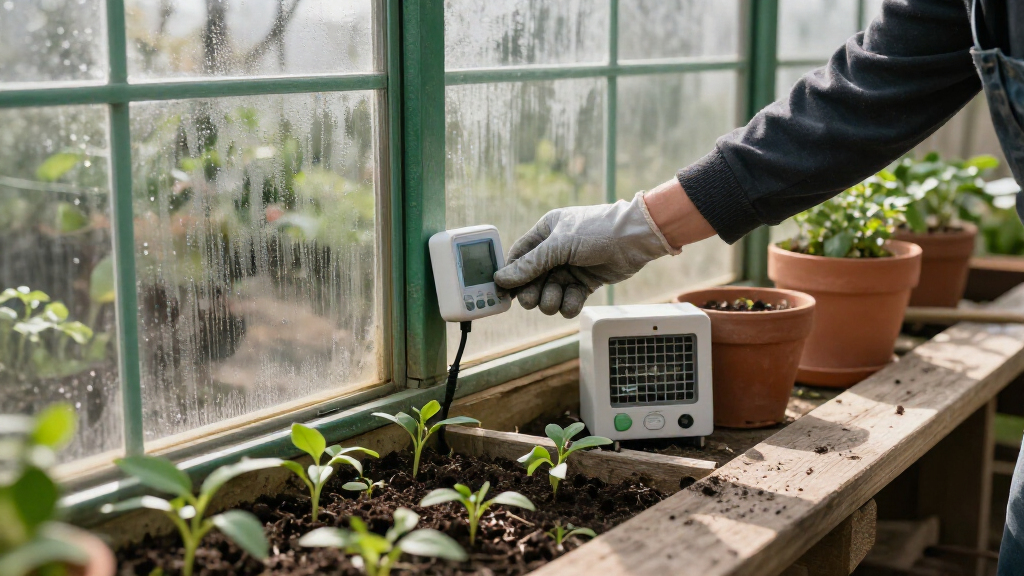
A thermostat can only respond to the temperature its sensor reads, so mounting location shapes how it behaves. A sensor near the heater may shut heating off before distant plants warm, while one next to cold glazing or a draft can keep the heater running longer than needed. Position the probe around plant height in a representative area, away from direct heater airflow and direct sun. If the greenhouse has distinct warm and cold zones, one sensor may not describe conditions throughout the space. A separate thermometer can help you compare the thermostat reading with temperatures at vulnerable plant locations.
Decide whether remote monitoring is worth the added complexity
WiFi and app controls can help you check conditions when you are away, but they introduce dependence on connectivity, account setup, and software. Before paying for connected features, check whether the heater still offers local thermostat operation if the network goes down. Ask whether alerts report temperature changes, device status, or only app connectivity; those are different kinds of reassurance. A display and simple controls may be easier for a nearby greenhouse that you can check in person. Remote access is most useful when it solves a real monitoring problem, not just when it adds another feature to manage.
Plan for moisture, maintenance, and safe operation
Greenhouses combine warmth, water, and condensation, so a heater’s intended environment and required clearances deserve attention. Follow the manufacturer’s instructions for placement, ventilation, cleaning, and keeping the unit away from irrigation spray or standing water. A thermostat does not replace built-in overheat protection, safe electrical installation, or supervision appropriate to the device. Check filters, air inlets, and sensor connections periodically, since dust or blockage can affect operation. If the product information does not clearly address greenhouse use or wet-area precautions, seek clarification before installing it.
Frequently Asked Questions
Can I use a plug-in greenhouse thermostat with a heater I already own?
Often, but compatibility must be checked rather than assumed. Compare the heater’s electrical load with the controller’s rated limits, and confirm that the heater restarts safely when power is switched by an external thermostat. Some heaters have internal electronic controls or settings that complicate plug-in control. Follow both manufacturers’ instructions, including any guidance about extension cords and damp locations. If the heater manual does not permit external switching, choose a compatible heater-controller combination instead.
Is a 1500W greenhouse heater enough for my space?
Wattage alone cannot answer that because heat demand changes with greenhouse size, glazing, air leakage, insulation, wind, and outdoor lows. A compact, sheltered structure may hold temperature more easily than a larger greenhouse with the same floor area but more exposed surfaces. Work out the temperature you need to maintain and estimate heat loss for your local conditions. Avoid assuming that several 1500W units can share one circuit; check electrical capacity and installation requirements first. If plants have different temperature needs, separate zones may be more practical than heating the whole structure uniformly.
Should I choose WiFi control or a basic thermostat?
Choose WiFi when remote temperature checks or alerts solve a real problem, such as being unable to visit the greenhouse regularly. A basic thermostat is often easier when the greenhouse is nearby and you want fewer setup steps or network dependencies. Check whether a connected heater keeps operating through local controls if the internet or app is unavailable. Also distinguish temperature alerts from connectivity alerts; an app may not provide both. Whichever style you choose, keep a way to check actual plant-level temperatures rather than relying only on a remote dashboard.
Where should I put the thermostat sensor in a greenhouse?
Place it around the height of the plants you are protecting, in a spot that reflects the typical growing area. Keep it away from direct heater airflow, sunlight on the sensor, cold glazing, and drafts that could skew its reading. In a long or divided greenhouse, a single sensor may miss colder zones at the far end. Compare its reading with a separate thermometer in a few locations during cold weather. If readings vary widely, adjust sensor placement or consider a heating arrangement designed for more even coverage.
Is a separate thermostat controller better than a heater with a built-in thermostat?
A separate controller can give owners more choice over the heater and may be easier to replace independently, but it adds another component and a compatibility check. A built-in thermostat keeps the setup simpler and avoids an external controller, though the control options are limited to those offered by that heater. If you need to manage an existing heater, a controller such as a plug-in model may be a practical route only when its electrical rating and switching method match. If you are buying new equipment and prefer fewer setup decisions, an all-in-one heater may suit you better. Neither arrangement guarantees accurate plant temperatures without thoughtful sensor placement.
Conclusion
For most buyers who already have a compatible heater, I would start with the INKBIRD 15A Plug-In Programmable Temperature Controller as the best overall balance of flexible control and straightforward purpose. The DEWENWILS 15A Temperature Controller Outlet with VA Display is my best value-style pick for shoppers who want a controller with a visible display, while the Inkbird ITC-308 is the best premium choice for buyers who can make use of its dual-outlet control. For beginners buying a complete setup, the SmterCon Greenhouse Heater with Thermostat is a more direct starting point than pairing a separate controller and heater. For small grow tents and app-focused monitoring, choose the VIVOSUN AeroFlux 700W; for a connected 1500W heater, compare the Pasapair and lesotc options closely against your app and local-control needs. Before buying any pick, verify load limits, greenhouse suitability, sensor placement, and safe installation for your space.
Fall Picks

eufy Security Essential 7-Piece Alarm System
As an affiliate, we earn on qualifying purchases.