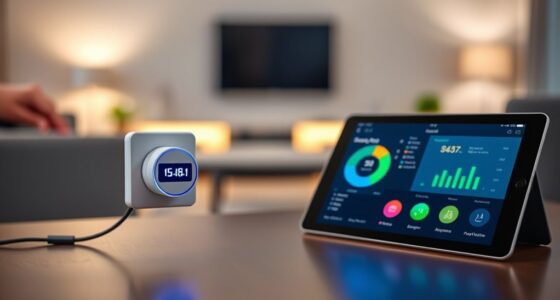

A privacy-first smart home emphasizes local control options, allowing you to manage your devices without relying on cloud services. By using edge AI, your devices can process data directly on-site, keeping sensitive information within your home. This approach reduces exposure to hacking, limits third-party access, and gives you greater transparency and control over your data. Staying within this framework guarantees your privacy stays protected—exploring further reveals how to implement these smart, secure solutions effectively.
Key Takeaways
- Local control systems store and process data within the home, minimizing reliance on cloud services.
- Edge AI enables real-time device analysis on-site, reducing sensitive data transfer outside the household.
- Privacy-focused smart homes offer customizable settings to manage data access and sharing locally.
- Security features in local systems protect data sovereignty and prevent unauthorized external access.
- Maintaining local control enhances transparency, user authority, and overall privacy in smart home environments.

As smart home technology becomes more integrated into daily life, prioritizing privacy is vital to protect your personal information. With devices constantly collecting data, it’s natural to worry about who has access to that information and how it’s being used. One effective way to maintain control is by opting for local control options, which allow you to manage your smart home without relying heavily on cloud services. This approach not only enhances privacy but also leverages technologies like edge AI, which processes data directly on your devices rather than sending it to external servers. By doing so, you help guarantee your data remains within your control, reinforcing data sovereignty—the principle that you should have authority over your personal data.
Using edge AI in your smart home means that many processing tasks happen right on the device itself. For example, a smart camera equipped with edge AI can analyze video footage locally, only transmitting relevant clips or alerts rather than continuous streams. This minimizes the amount of sensitive data leaving your home, reducing exposure to potential breaches or unauthorized access. It also means your devices can operate more efficiently, with faster response times since they don’t need to communicate with distant servers. By prioritizing local processing, you’re taking a proactive stance on privacy, ensuring your personal information stays within your household’s boundaries. Additionally, many security protocols integrated into local control systems are designed with security features that further protect your data from cyber threats.
Edge AI analyzes data locally, reducing data transfer and increasing privacy in your smart home.
Data sovereignty is a vital aspect of a privacy-first smart home because it emphasizes your right to control your data. When you choose devices and systems that support local control, you’re effectively asserting your authority over your personal information. Many smart home manufacturers now offer options to keep data on your local network, giving you peace of mind that sensitive information isn’t stored in the cloud or shared with third parties. This also means you can customize your privacy settings more precisely, knowing exactly where your data is stored and how it’s used.
Furthermore, opting for local control can simplify your smart home setup by reducing dependence on external servers, which can sometimes be unreliable or vulnerable to hacking. It allows for greater transparency, so you understand exactly how your system operates and how your data flows. This approach aligns with a privacy-first mindset, giving you peace of mind that your personal data remains under your control. Ultimately, integrating local control options with edge AI technology empowers you to enjoy the benefits of a smart home without compromising your privacy or data sovereignty.

Amazon Echo Hub (newest model), 8” smart home control panel, Designed for Alexa+, Compatible with thousands of devices
Echo Hub — An easy-to-use Alexa-enabled control panel for your smart home devices—just ask Alexa or tap the…
As an affiliate, we earn on qualifying purchases.
As an affiliate, we earn on qualifying purchases.
Frequently Asked Questions
How Do Local Control Options Impact Smart Home Device Compatibility?
Local control options can limit your smart home device compatibility because they often rely on specific protocols, affecting device interoperability. However, they enhance user privacy by keeping data within your local network rather than cloud servers. This means you might face fewer compatible devices, but your personal information stays protected. Balancing device interoperability and user privacy is key to creating a smart home that’s both functional and secure.
Are There Specific Privacy Regulations for Local Smart Home Controls?
Think of local smart home controls as your home’s fortress, safeguarding your privacy. Yes, there are privacy regulations you should follow. These laws often require data encryption to protect your information and demand clear user consent before collecting any data. Staying compliant means understanding these rules, ensuring your devices prioritize your privacy, and maintaining control. This way, you keep your smart home secure and your personal data truly protected.
What Are the Cost Differences Between Local and Cloud-Based Smart Home Solutions?
The cost comparison shows that local smart home solutions often have higher upfront costs but lower ongoing fees, making them budget-friendly over time. Cloud-based options may be cheaper initially but can rack up subscription fees, increasing overall expenses. If you prioritize budget considerations, weigh the higher initial investment of local systems against the recurring costs of cloud services to choose what fits your financial plan best.
How Do Local Control Options Affect Smart Home System Scalability?
Local control options often enhance scalability by reducing reliance on external servers, allowing your system to grow smoothly. With 85% of smart home users valuing network security, this setup minimizes exposure to cloud vulnerabilities. Plus, you gain user convenience since local controls respond faster and remain operational during internet outages. This means your smart home can expand seamlessly, maintaining secure and reliable performance without sacrificing ease of use.
Can Local Control Methods Be Integrated With Existing Smart Home Platforms?
Yes, you can integrate local control methods with existing smart home platforms. You’ll often use voice commands to manage devices directly through local control, avoiding reliance on cloud services. Guarantee encryption protocols are in place to secure your data during communication. This setup lets you enjoy seamless control while maintaining privacy, and it’s compatible with many popular platforms, making your smart home both more private and easier to operate.

Aqara Smart Home Hub M3 for Advanced Automation, Matter Controller, Thread Border Router, Features Zigbee, Bluetooth, Wi-Fi, PoE, IR, Supports Apple HomeKit, Alexa, SmartThings, Home Assistant, IFTTT
[Multi-Protocol Hub with Matter Bridge] The M3 is a versatile hub supporting Aqara Zigbee and Thread devices. It…
As an affiliate, we earn on qualifying purchases.
As an affiliate, we earn on qualifying purchases.
Conclusion
Imagine a smart home that keeps your privacy intact, where your data stays local and secure. While many devices chase convenience through constant connectivity, you choose control and peace of mind. In a world of surveillance and data breaches, your privacy-first smart home stands as a refuge—balancing modern technology with personal boundaries. You gain not just smarter living, but a space where your privacy isn’t sacrificed for convenience. That’s the true power of local control.

Security Cameras Wireless Outdoor Indoor, 2K Battery Powered WiFi Camera for Home Security, AI Motion Detection, Color Night Vision, IP66 Weatherproof, 2-Way Talk, Siren Alarm, SD/Cloud Storage
【24/7 Smart Surveillance & AI-Powered Precision】This security camera combine PIR motion detection and advanced AI analytics to guard…
As an affiliate, we earn on qualifying purchases.
As an affiliate, we earn on qualifying purchases.

Aqara Smart Hub M200, Matter Controller, Thread Border Router, Featuring Aqara Zigbee, Bluetooth, Wi-Fi, PoE, IR, Supports Amazon Alexa, Apple HomeKit, Home Assistant, SmartThings, Google Home
[Multi-Protocol Hub with Matter Bridge] The Aqara Hub M200 is a versatile smart hub that supports multiple advanced…
As an affiliate, we earn on qualifying purchases.
As an affiliate, we earn on qualifying purchases.