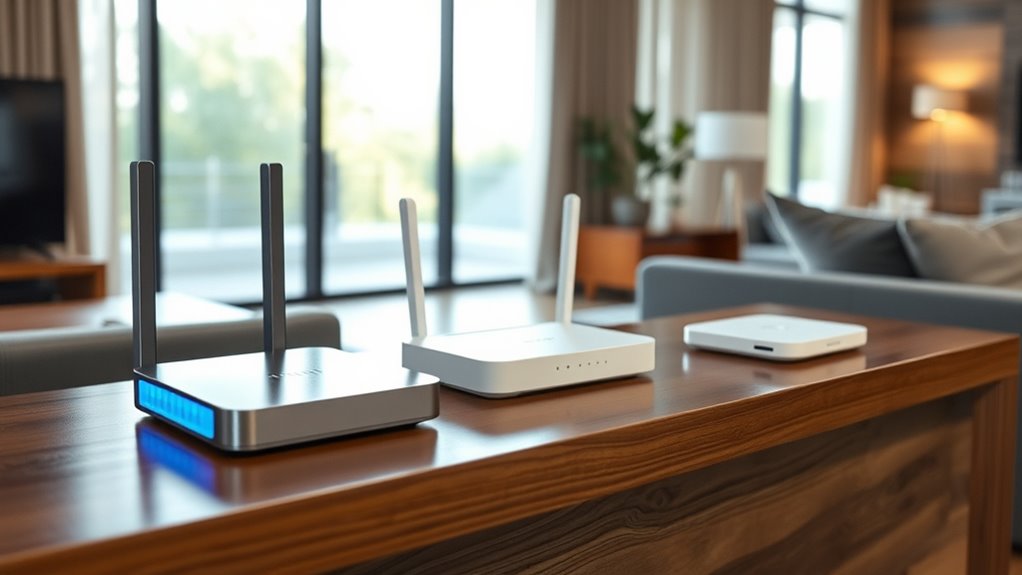

When building a reliable mesh network, consider that Thread and Zigbee are designed for resilience with decentralized, mesh architectures that adapt to power outages and interference, ensuring continuous operation. Wi-Fi, relying on centralized routers, is more vulnerable to disruptions and congestion, especially in challenging environments. Both Thread and Zigbee use channel-hopping and dynamic routing to maintain connection stability, making them ideal for tough conditions. Curious about how to choose the best option? Keep exploring these differences.
Key Takeaways
- Thread and Zigbee use decentralized mesh architectures, providing greater resilience during power outages and device failures.
- Wi-Fi relies on centralized routers, making it more vulnerable to outages and interference, affecting network reliability.
- Mesh topologies in Thread and Zigbee enable dynamic routing around interference, enhancing communication stability.
- Wi-Fi mitigates interference through channel selection and dual-band operation, but remains more susceptible than mesh-based protocols.
- For challenging environments, Thread and Zigbee offer superior reliability due to their low-power, self-healing mesh networks.
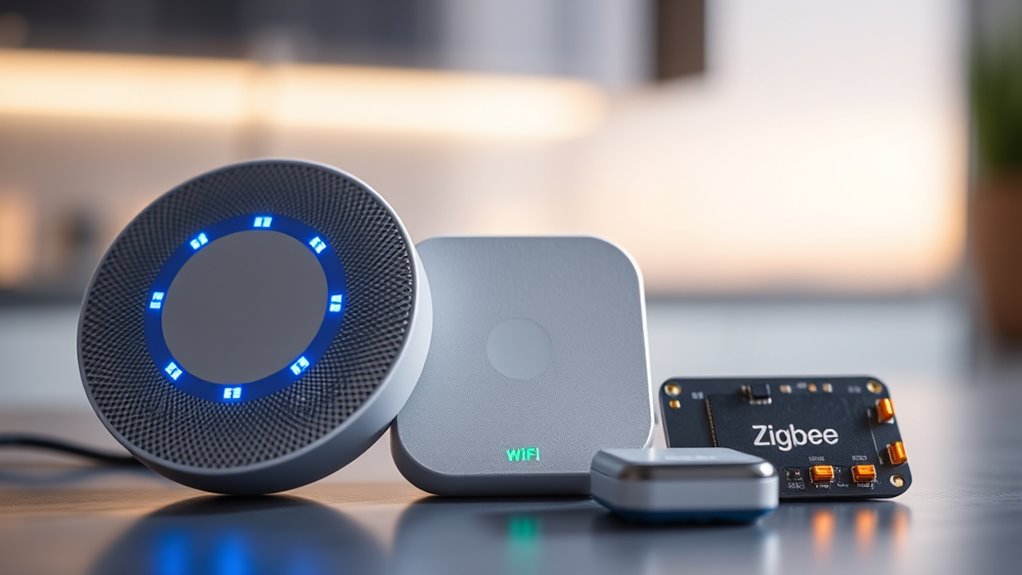
Ever wondered how to guarantee your network remains stable and resilient? When building a reliable mesh network, understanding the strengths and limitations of different protocols is essential, especially in the face of challenges like power outages and interference. Each protocol—Wi-Fi, Thread, and Zigbee—handles these issues differently, so choosing the right one depends on your specific needs.
Power outages are a common disruptor, especially in smart homes and IoT setups. Wi-Fi networks often rely on centralized routers, which means a power outage can bring your entire system to a halt. To mitigate this, many users opt for battery backups or uninterruptible power supplies (UPS), but even then, the network’s stability depends on the router’s resilience. In contrast, both Thread and Zigbee are designed with low-power, decentralized architectures. They operate on mesh topologies where nodes communicate directly with each other, reducing the impact of a single point of failure. If a device loses power, the rest of the network can often reroute data through other nodes, maintaining connectivity. This inherent resilience makes Thread and Zigbee particularly suited for environments prone to power interruptions, ensuring your network stays operational even during outages.
Interference mitigation is another critical factor. Wi-Fi operates in crowded 2.4 GHz and 5 GHz bands, which are shared with many household devices like microwaves, Bluetooth gadgets, and cordless phones. This congestion can cause significant interference, leading to slower speeds and dropped connections. To combat this, Wi-Fi networks often utilize channels and dual-band capabilities, but interference remains a persistent issue, especially in dense environments. On the other hand, Thread and Zigbee use the 2.4 GHz band as well, but they implement advanced channel-hopping and frequency agility techniques. These protocols dynamically switch channels to avoid interference, and their mesh architecture allows data to find alternative routes around congested areas. This adaptability enhances reliability, especially in environments with high electromagnetic interference. Additionally, nutrient retention during juice extraction can influence the effectiveness of vegetable juices in supporting overall health.
As an affiliate, we earn on qualifying purchases.
Frequently Asked Questions
How Do Mesh Protocols Affect Device Battery Life?
Mesh protocols can impact your device’s battery life by affecting battery drain and power optimization. When a protocol requires frequent communication between devices, it can increase power consumption, leading to quicker battery drain. However, protocols like Zigbee and Thread are designed for low power, enabling better power optimization. To extend your device’s battery life, choose a mesh protocol that balances reliable connectivity with minimal power use, such as Zigbee or Thread.
Can Multiple Mesh Types Be Integrated Within the Same Network?
You can combine multiple mesh types in one network, but it’s like mixing oil and water—interoperability challenges and protocol compatibility issues can crop up. To make it work smoothly, you need compatible devices and possibly a hub or gateway that bridges different protocols. Proper planning guarantees seamless communication, but without it, you risk creating a patchwork that hampers reliability and performance.
Which Mesh Technology Offers the Best Security Features?
You’ll find that Zigbee offers the best security features, thanks to strong encryption standards like AES-128 and robust authentication methods. It regularly updates its security protocols, making it harder for attackers to breach your network. Wi-Fi also provides good security, but Zigbee’s low-power design and focus on secure device communication make it ideal for smart home devices that need reliable, protected connections.
How Scalable Are Wi-Fi, Thread, and Zigbee Networks?
Wi-Fi networks are highly scalable, supporting high device density and easy network expansion, making them ideal for large homes or offices. Thread networks also scale well, especially in smart home setups, as they efficiently handle numerous devices with low power consumption. Zigbee offers good scalability too but may require more careful management of device density and network expansion to maintain reliability. Overall, Wi-Fi excels in large-scale, device-dense environments.
What Are the Cost Differences Among These Mesh Options?
Imagine a world where your smart home is as affordable as a vintage radio. Wi-Fi usually costs more upfront due to higher hardware expenses and bandwidth needs, offering better cost efficiency at scale. Thread and Zigbee are cheaper initially, with lower hardware costs, making them ideal for smaller setups. However, their long-term costs depend on network complexity, so choose based on your budget and future expansion plans.
Conclusion
When choosing a mesh protocol, consider your specific needs. Wi-Fi offers high speeds but can struggle with reliability in dense setups, while Thread and Zigbee excel in low-power, resilient networks. Did you know that Zigbee devices make up over 60% of smart home mesh networks worldwide? This highlights their growing dominance in creating reliable, scalable smart environments. Ultimately, selecting the right protocol depends on balancing speed, power, and stability for your unique home or project.