For deep sky imaging, cooled CMOS astro cameras offer a compelling balance of sensitivity, resolution, and affordability. The ZWO ASI183MC Pro stands out as the best overall choice thanks to its high resolution and excellent noise control. The SVBONY SV605CC is a strong value pick with versatile features, while the SVBONY SV405CC is ideal for those new to astrophotography seeking a budget-friendly option. Buyers often face tradeoffs between resolution, cooling capacity, and ease of use, making it essential to prioritize your specific imaging goals. Continue reading for a detailed breakdown of these options and what sets each apart.

Get garden gear delivered free with Prime
- Fast, free delivery on millions of items
- Prime Video, Amazon Music and more included
- Member-only deals all year
Complete the kit


Key Takeaways
- The top-ranked cameras balance high resolution with effective cooling to reduce noise during long exposures.
- Models with dual-band filters or filter drawers add versatility for different astrophotography targets.
- Higher megapixel counts generally improve image detail but may demand more processing power and storage.
- Ease of use and build quality vary significantly; beginners should prioritize intuitive controls and reliable construction.
- Value isn’t solely about price—investing in a well-cooled, high-quality sensor yields better results over time.
| SVBONY SV405CC Telescope Camera, TEC Cooled 11.7 MP CMOS Color Astronomy Camera with UV/IR Cut Filter |  | Best Overall for Deep Sky Imaging | Sensor: IMX294 CMOS | Resolution: 11.7 MP | Frame Rate: 120 fps (full resolution) | VIEW ON AMAZON | See Our Full Breakdown |
| SVBONY SV605CC Cooled Astrophotography Camera with 2″ Dual-Band Nebula Filter |  | Best for Light-Polluted Deep Sky Imaging | Sensor: IMX533 1-inch CMOS | Resolution: 3008×3008 | Pixel Size: 3.76μm | VIEW ON AMAZON | See Our Full Breakdown |
| SVBONY Astrophotography Accessories SC571CC Telescope Camera with UV IR Cut Filter |  | Best for High-Resolution Deep Sky Imaging | Sensor: IMX571 APS-C BSI | Resolution: 26MP | Sensor Size: 23.4×15.7mm | VIEW ON AMAZON | See Our Full Breakdown |
| 16MP Monochrome TE Cooling Astronomy Camera for Telescopes |  | Best for Monochrome Astro Imaging | Sensor Resolution: 16MP | Cooling Technology: TE cooling | Filter: IR-Cut | VIEW ON AMAZON | See Our Full Breakdown |
| SVBONY SC571CC Telescope Camera with Dual-Band Nebula Filter and Filter Drawer | 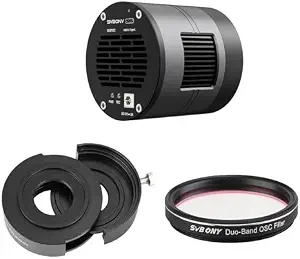 | Best Overall for High-Resolution, Versatile Deep Sky Imaging | Sensor: IMX571 APS-C BSI CMOS | Resolution: 26MP | Sensor Size: 23.4×15.7mm | VIEW ON AMAZON | See Our Full Breakdown |
| SVBONY SV550 Telescope, 80ED F6 Triplet Apochromatic Refractor OTA, SV405CC Cooled Astrophotography Camera, SV905C Guide Camera, SV106 Guide Scope with Helical Focuser Finder, SV209 Field Flattener |  | Best for Beginners and Intermediate Deep Sky Imaging with Complete Setup | Telescope Aperture: 80mm | Focal Ratio: F6 | Optics Type: Triplet Apochromatic Refractor | VIEW ON AMAZON | See Our Full Breakdown |
| SVBONY SC571CC Telescope Camera with SV241 Pro Power Management Box for Astrophotography |  | Best for Stable, Long-Exposure Deep Sky Imaging with Power Management | Sensor: IMX571 APS-C BSI CMOS | Resolution: 26MP | Cooling: Dual-stage TEC, -35°C below ambient | VIEW ON AMAZON | See Our Full Breakdown |
| SVBONY SV405CC Astrophotography Camera, Cooled Telescope Eyepiece IMX294 |  | Best for High-Sensitivity, Professional-Grade Deep Sky Imaging | Sensor: Back-illuminated IMX294, 4/3″ | Pixel Size: 4.63 μm | Resolution: 4144×2822 | VIEW ON AMAZON | See Our Full Breakdown |
| SVBONY Deep-Sky Master SC571CC Camera and SV238 OAG with M48 Filter Drawer |  | Best for High-Resolution, Professional Deep Sky Imaging Workflow | Sensor: IMX571 APS-C 26MP | Cooling: Dual-stage TEC, -35°C | Back Focal Length: 55mm | VIEW ON AMAZON | See Our Full Breakdown |
| cooled cmos astro cameras for deep sky imaging | Sensor | Cooling | Resolution | Filter |
|---|---|---|---|---|
| SVBONY SV405CC Telescope Camer | IMX294 CMOS | TEC cooling | 11.7 MP | UV/IR Cut |
| SVBONY SV605CC Cooled Astropho | IMX533 1-inch CMOS | Double-layer semiconductor refrigeration | 3008×3008 | SV220 2" dual-band |
| SVBONY Astrophotography Access | IMX571 APS-C BSI | Dual-stage TEC | 26MP | UV-IR Cut |
| 16MP Monochrome TE Cooling Ast | — | — | — | IR-Cut |
| SVBONY SC571CC Telescope Camer | IMX571 APS-C BSI CMOS | Dual-stage TEC, -35°C below ambient | 26MP | SV220 7nm dual-band nebula filter |
| SVBONY SV550 Telescope | — | — | — | — |
| SVBONY SC571CC Telescope Camer | IMX571 APS-C BSI CMOS | Dual-stage TEC, -35°C below ambient | 26MP | — |
| SVBONY SV405CC Astrophotograph | Back-illuminated IMX294, 4/3" | Two-stage TEC, up to 30°C below ambient | 4144×2822 | — |
| SVBONY Deep-Sky Master SC571CC | IMX571 APS-C 26MP | Dual-stage TEC, -35°C | — | — |
More Details on Our Top Picks
SVBONY SV405CC Telescope Camera, TEC Cooled 11.7 MP CMOS Color Astronomy Camera with UV/IR Cut Filter
The SV405CC stands out as the most balanced choice among cooled CMOS astro cameras, thanks to its high-resolution 11.7 MP sensor and TEC cooling that effectively reduces noise during extended exposures. Unlike the ZWO ASI183MC Pro, which offers higher megapixels, the SV405CC’s simpler interface and broader compatibility make it more approachable for serious amateurs. Its USB 3.0 connection ensures swift data transfer, but the setup can be somewhat complex for beginners unfamiliar with astrophotography workflows. The inclusion of a UV/IR cut filter enhances image contrast, making it ideal for capturing nebulae and galaxies with clarity. However, the limited info on bundled accessories may require buyers to invest in additional gear. Overall, this camera excels for dedicated deep-sky imaging at a reasonable price point, provided you have compatible equipment and some technical patience.
Pros:- High-resolution 11.7 MP sensor captures detailed images
- TEC cooling significantly reduces sensor noise during long exposures
- Fast USB 3.0 interface enables quick data transfer
- Includes UV/IR cut filter for improved image clarity
Cons:- Requires compatibility with existing astrophotography setups, which may involve complex configuration
- Setup complexity may challenge newcomers with limited technical experience
Best for: Intermediate to advanced amateur astronomers seeking high detail and reliable performance in deep sky imaging
Not ideal for: Beginners who need plug-and-play simplicity or a camera with extensive bundled accessories
- Sensor:IMX294 CMOS
- Resolution:11.7 MP
- Frame Rate:120 fps (full resolution)
- Interface:USB 3.0
- Filter:UV/IR Cut
- Cooling:TEC cooling
Our verdict“This camera is best suited for dedicated deep-sky astrophotographers who want detailed, low-noise images and are comfortable with a more involved setup.”
SVBONY SV605CC Cooled Astrophotography Camera with 2″ Dual-Band Nebula Filter
The SV605CC offers impressive sensitivity with its 9MP IMX533 sensor, making it a top pick for capturing nebulae and galaxies in challenging light conditions. Compared to the SV405CC, which has higher resolution but less specialized filtering, the SV605CC’s dual-band nebula filter and advanced cooling system provide a distinct advantage in high light pollution environments. Its double-layer semiconductor refrigeration cools the sensor to 30°C below ambient, drastically reducing noise. While the camera’s advanced features are appealing, they come with a steeper learning curve, and it’s better suited for experienced astrophotographers who understand filter integration and cooling management. The device’s build quality and dedicated nebula filter make it ideal for those aiming to optimize images in urban or suburban skies, but beginners may find it overwhelming.
Pros:- High sensitivity and low noise for detailed deep-sky captures
- Effective cooling system reduces sensor noise significantly
- Includes a 2″ dual-band nebula filter for emission line enhancement
- Robust construction suitable for serious astrophotography
Cons:- Requires compatible telescope and filter management skills
- Complex operation may challenge newcomers
Best for: Astrophotographers working in light-polluted areas seeking detailed nebula and galaxy images
Not ideal for: Beginners or casual observers who prefer straightforward setups without specialized filters
- Sensor:IMX533 1-inch CMOS
- Resolution:3008×3008
- Pixel Size:3.76μm
- Cooling:Double-layer semiconductor refrigeration
- Filter:SV220 2″ dual-band
- Weight:50g
Our verdict“This camera is tailored for experienced astrophotographers aiming for high-contrast images in light-polluted environments, despite its complexity.”
SVBONY Astrophotography Accessories SC571CC Telescope Camera with UV IR Cut Filter
The SC571CC combines a 26MP APS-C sensor with dual-stage TEC cooling, making it a strong choice for capturing highly detailed images of nebulae, star fields, and galaxies. Its high resolution surpasses the ZWO ASI183MC Pro’s 20.1 MP sensor, delivering finer detail, especially for astrophotographers who want large prints or extreme crop capability. The inclusion of a front-window heater and durable UV-IR cut filter enhances image quality and prevents dew issues during long sessions. Still, the setup may be daunting for beginners because of the high resolution and cooling system’s complexity. Unlike the simpler SV405CC, which is more straightforward but lower in pixel count, the SC571CC is designed for those willing to invest time in mastering their equipment for maximum detail. It’s especially suitable for serious deep-sky work requiring high resolution and durability.
Pros:- High-resolution 26MP sensor captures ultra-detailed images
- Dual-stage TEC cooling effectively reduces noise during long exposures
- Built-in dew prevention with front-window heater
- Durable UV-IR cut filter enhances contrast and detail
Cons:- Complex setup may be challenging without prior experience
- Higher cost may be prohibitive for casual users
Best for: Advanced astrophotographers dedicated to high-resolution deep sky imaging and willing to manage complex setups
Not ideal for: Newcomers or casual users who prefer easier, less technical cameras with fewer features
- Sensor:IMX571 APS-C BSI
- Resolution:26MP
- Sensor Size:23.4×15.7mm
- Pixel Size:3.76 µm
- Cooling:Dual-stage TEC
- Filter:UV-IR Cut
Our verdict“This camera is ideal for dedicated astrophotographers seeking maximum detail with high-resolution sensors, despite its technical complexity.”
16MP Monochrome TE Cooling Astronomy Camera for Telescopes
The 16MP TE-cooled monochrome camera offers a versatile platform for capturing detailed images of planets, stars, and deep-sky objects. Its monochrome sensor is a double-edged sword: it excels in resolving fine detail but requires color filters for true-color imaging, unlike the color models like the ZWO ASI183MC Pro. The TEC cooling reduces noise effectively, making it suitable for long exposures. Compared to the SV405CC, which is color-based, this camera emphasizes resolution and contrast, appealing to those who prioritize detail over immediate color. The user-friendly software simplifies image processing, though beginners might find the monochrome approach less straightforward initially. It’s best suited for users who want high-resolution images and are comfortable adding color filters and managing monochrome workflows.
Pros:- High-resolution 16MP sensor captures detailed images
- TEC cooling reduces noise during long exposures
- Compatible with a variety of telescope setups
- User-friendly software streamlines image processing
Cons:- Requires additional filters for color imaging
- More complex workflow compared to color cameras
Best for: Astrophotographers focused on monochrome imaging and fine detail, particularly in planetary or star field work
Not ideal for: Beginners seeking quick, colorful astrophotography with minimal setup
- Sensor Resolution:16MP
- Cooling Technology:TE cooling
- Filter:IR-Cut
- Application:Astrophotography
Our verdict“This monochrome camera is perfect for advanced users who value resolution and contrast, accepting the extra steps for color imaging.”
SVBONY SC571CC Telescope Camera with Dual-Band Nebula Filter and Filter Drawer
The SVBONY SC571CC stands out for its high-resolution 26MP APS-C sensor, delivering detailed images that surpass many 20MP options like the ZWO ASI183MC Pro, especially when capturing faint deep-sky objects. Its dual-stage TEC cooling and integrated heater help maintain low noise levels during long exposures, which is vital for astrophotography. The included dual-band nebula filter and filter drawer simplify capturing emission nebulae, making it a comprehensive package for serious deep sky imagers. However, the setup involves more complexity than smaller cameras, requiring users to be comfortable with calibration and system integration. The added cooling and filtering features come at a higher cost and increased system complexity. This camera makes the most sense for advanced enthusiasts seeking detailed, high-precision images without sacrificing versatility.
Pros:- High-resolution 26MP sensor captures fine detail in deep-sky objects
- Effective dual-stage TEC cooling reduces sensor noise during long exposures
- Includes dual-band nebula filter and filter drawer for targeted imaging
- Integrated heater prevents dew buildup on the front window
Cons:- Complex setup requiring technical knowledge and calibration
- Higher cost due to advanced cooling and filtering hardware
Best for: Deep sky astrophotographers who want high resolution and integrated filtering for detailed nebula and galaxy imaging
Not ideal for: Beginners or those seeking a plug-and-play solution, due to its complex setup and advanced features
- Sensor:IMX571 APS-C BSI CMOS
- Resolution:26MP
- Sensor Size:23.4×15.7mm
- Pixel Size:3.76 µm
- Cooling:Dual-stage TEC, -35°C below ambient
- Filter:SV220 7nm dual-band nebula filter
Our verdict“This camera suits experienced deep sky astrophotographers demanding high resolution and versatile imaging capabilities.”
SVBONY SV550 Telescope, 80ED F6 Triplet Apochromatic Refractor OTA, SV405CC Cooled Astrophotography Camera, SV905C Guide Camera, SV106 Guide Scope with Helical Focuser Finder, SV209 Field Flattener
This bundle centers around the SV405CC cooled camera, paired with an 80mm F6 triplet apochromatic refractor, creating a balanced platform for capturing nebulae, galaxies, and star clusters. The high-quality triplet optics ensure sharp, color-accurate images, while the cooled sensor reduces noise during extended exposures. The included guide camera and scope with a helical focuser facilitate precise tracking, making this ideal for newcomers who want a straightforward, all-in-one setup. Compared to the more advanced SVBONY SC571CC, this bundle is less complex and more accessible but limits resolution and filter options. It’s perfect for hobbyists stepping into serious deep sky imaging without overwhelming complexity, though it’s less suited for highly detailed imaging or planetary work.
Pros:- High-quality triplet apochromatic optics deliver sharp, true-color images
- Cooled camera reduces sensor noise for long exposures
- Includes guiding system for better tracking accuracy
- All-in-one package simplifies setup for newcomers
Cons:- Limited to deep sky objects; not optimized for planetary imaging
- Additional accessories may be needed for advanced features
Best for: Beginners or intermediate astrophotographers looking for a complete, user-friendly deep sky setup
Not ideal for: Advanced users seeking maximum resolution or specialized filter configurations, since it’s tailored for ease of use
- Telescope Aperture:80mm
- Focal Ratio:F6
- Optics Type:Triplet Apochromatic Refractor
- Deep Sky Camera:SV405CC, IMX294 sensor
- Guide Camera:SV905C, 1/3” CMOS
- Guide Scope:SV106 with helical focuser
Our verdict“This bundle offers a compelling entry point for enthusiasts wanting a straightforward deep sky imaging experience with quality optics.”
SVBONY SC571CC Telescope Camera with SV241 Pro Power Management Box for Astrophotography
The SVBONY SC571CC paired with the SV241 Pro Power Management Box offers a reliable solution for long-exposure deep sky imaging. The camera’s 26MP APS-C sensor delivers high detail, comparable to the ZWO ASI183MC Pro but with added emphasis on power stability. The dual-stage TEC cooling ensures low noise during extended sessions, while the power management system maintains consistent voltage and current, reducing system crashes during long imaging runs. This setup is ideal for users who operate in remote or less-controlled environments, where stable power is crucial. Compared to standalone cameras, this combo adds a layer of reliability but complicates the setup process, as the power box requires careful handling and setup. It’s best suited for dedicated deep sky imagers who value stability over simplicity.
Pros:- High-resolution 26MP sensor captures detailed images
- TEC cooling maintains low noise levels during long exposures
- Power management ensures stable operation in various environments
- Compatible with multiple telescope types
Cons:- Requires careful handling and setup of power box
- No hot-swapping support; must power down before disconnecting
Best for: Deep sky astrophotographers who need stable power and consistent long-exposure performance
Not ideal for: Beginners or casual users who prefer simple, plug-and-play solutions, due to additional setup complexity
- Sensor:IMX571 APS-C BSI CMOS
- Resolution:26MP
- Cooling:Dual-stage TEC, -35°C below ambient
- Compatibility:APO, Newtonian, RC scopes
- Power Management:SV241 Pro
Our verdict“This combination is ideal for dedicated deep sky imagers prioritizing system stability and reliable power for extended imaging sessions.”
SVBONY SV405CC Astrophotography Camera, Cooled Telescope Eyepiece IMX294
The SVBONY SV405CC features a back-illuminated IMX294 sensor with a large 4/3″ format, making it one of the most sensitive cameras in this roundup. Its broad spectral response and high full-well capacity enable capturing faint deep-sky objects with remarkable clarity. The two-stage TEC cooling keeps the sensor temperature up to 30°C below ambient, significantly reducing thermal noise. This camera’s USB 3.0 interface and 14-bit ADC support high-speed data transfer, ideal for capturing high-resolution, long-exposure images efficiently. Compared with smaller sensors like the IMX294 used in the SV405CC, the larger sensor provides a wider field of view, but it also demands more from the mount and guiding system. This camera is perfect for advanced astrophotographers who need sensitivity and speed, but it can be overwhelming for beginners due to its complex setup and software requirements.
Pros:- Large 4/3″ sensor for wide, detailed deep sky images
- Effective two-stage TEC cooling reduces thermal noise
- High-speed USB 3.0 data transfer supports rapid imaging
- Excellent for capturing faint objects and fine details
Cons:- Requires compatible, often high-performance hardware and software
- Complex setup and image processing may challenge newcomers
Best for: Experienced deep sky imagers seeking maximum sensitivity and large-format imaging capabilities
Not ideal for: Beginners or casual hobbyists who prefer simpler, less demanding systems
- Sensor:Back-illuminated IMX294, 4/3″
- Pixel Size:4.63 μm
- Resolution:4144×2822
- Cooling:Two-stage TEC, up to 30°C below ambient
- Interface:USB 3.0
- Buffer:256MB DDRIII
Our verdict“This camera suits experienced astrophotographers needing high sensitivity and wide-field imaging in professional or semi-professional workflows.”
SVBONY Deep-Sky Master SC571CC Camera and SV238 OAG with M48 Filter Drawer
The SVBONY SC571CC combined with the SV238 off-axis guider offers a robust platform for professional-grade deep sky imaging. The 26MP APS-C sensor provides exceptional detail, rivaling larger setups like the ZWO ASI6200, but with a more streamlined guide system thanks to the large prism of the SV238. The dual-stage TEC cooling and the M48 filter drawer facilitate high-quality, long exposures with minimal dew issues. Its seamless software compatibility makes integration into complex workflows straightforward. The main compromise lies in the higher cost and setup complexity—this is not a casual purchase. It’s best for professionals or dedicated amateurs who need high resolution and reliable guiding for their deep-sky projects.
Pros:- High-resolution 26MP sensor captures detailed deep sky images
- Large off-axis guider prism improves guiding accuracy
- Dual-stage TEC cooling reduces thermal noise in long exposures
- M48 filter drawer simplifies filter changes
Cons:- High cost and complex assembly process
- Requires significant technical expertise for setup and operation
Best for: Professional or serious amateur astrophotographers requiring high resolution and advanced guiding features
Not ideal for: Beginners or those seeking a simple, portable setup, due to its complexity and price
- Sensor:IMX571 APS-C 26MP
- Cooling:Dual-stage TEC, -35°C
- Back Focal Length:55mm
- Guide Prism Size:8x14mm
- Filter Drawer:M48
Our verdict“This system is tailored for experienced imagers needing high resolution, stable guiding, and workflow flexibility for professional results.”

How We Picked
Each camera was evaluated based on image sensor performance, cooling efficiency, build quality, and ease of integration with common astrophotography setups. We prioritized models with proven reputation, good reviews from the astrophotography community, and features that support high-quality deep sky imaging. Cost was considered relative to features and performance, ensuring options suited both hobbyists and more advanced users. The ranking reflects a balance between image quality, usability, and value, highlighting how different features serve different user needs and budgets.| cooled cmos astro cameras for deep sky imaging | Sensor | Filter | Cooling |
|---|---|---|---|
| SVBONY SV405CC Telescope Camer | IMX294 CMOS | UV/IR Cut | TEC cooling |
| SVBONY SV605CC Cooled Astropho | IMX533 1-inch CMOS | SV220 2" dual-band | Double-layer semiconductor refrigeration |
| SVBONY Astrophotography Access | IMX571 APS-C BSI | UV-IR Cut | Dual-stage TEC |
| 16MP Monochrome TE Cooling Ast | — | IR-Cut | — |
| SVBONY SC571CC Telescope Camer | IMX571 APS-C BSI CMOS | SV220 7nm dual-band nebula filter | Dual-stage TEC, -35°C below ambient |
| SVBONY SV550 Telescope | — | — | — |
| SVBONY SC571CC Telescope Camer | IMX571 APS-C BSI CMOS | — | Dual-stage TEC, -35°C below ambient |
| SVBONY SV405CC Astrophotograph | Back-illuminated IMX294, 4/3" | — | Two-stage TEC, up to 30°C below ambient |
| SVBONY Deep-Sky Master SC571CC | IMX571 APS-C 26MP | — | Dual-stage TEC, -35°C |
Factors to Consider When Choosing Cooled Cmos Astro Cameras For Deep Sky Imaging
Choosing the right cooled CMOS astro camera involves understanding several key factors that impact your imaging results and workflow. Beyond raw specifications, consider how each feature aligns with your observing conditions, target types, and experience level. A well-chosen camera can improve your images significantly, but investing in unnecessary features can add cost and complexity without benefit.Sensor Resolution and Megapixels
Higher resolution sensors capture more detail, which is advantageous for deep sky objects with fine structures. However, increasing megapixels can lead to larger file sizes, longer processing times, and sometimes more noise if the sensor isn’t cooled effectively. Balance your resolution needs with your computer’s processing capacity and storage solutions. For most amateur deep sky work, sensors around 16-20 MP strike a good compromise between detail and manageability.
Cooling Performance and Noise Reduction
Effective cooling is essential for deep sky imaging to minimize thermal noise during long exposures. Look for cameras with TEC cooling systems capable of maintaining stable, low temperatures—ideally at least 20°C below ambient. Poor cooling can lead to increased noise, requiring more post-processing. Keep in mind that higher cooling capacity often means higher cost and potential power requirements, so choose based on your typical imaging sessions.
Filter Compatibility and Versatility
Many cameras now include dual-band or filter drawer options, expanding their versatility. Filters can enhance contrast and detail by isolating specific wavelengths, such as hydrogen-alpha or oxygen III. If you plan to target specific nebulae or galaxies, cameras with built-in filter options make setup more straightforward. However, they tend to be more expensive and may require additional accessories for full functionality.
Ease of Use and Compatibility
Ease of integration with your existing setup, including mounts and control software, is a key consideration. Cameras with user-friendly interfaces and reliable drivers reduce frustration during setup and operation. For beginners, models with comprehensive support and straightforward calibration procedures are preferable. Advanced users might prioritize customization options and compatibility with stacking and processing software.
Price and Long-Term Value
While budget options can deliver impressive results, investing in a slightly more expensive, higher-quality camera often pays off through better durability, lower noise, and more consistent performance. Consider your long-term goals—if you plan to upgrade your telescope or expand your astrophotography skills, choosing a camera with room for growth can be a wise decision. Balance initial cost with anticipated longevity and performance gains.
Frequently Asked Questions
How important is cooling capacity for deep sky imaging?
Cooling capacity directly impacts your ability to capture clean, noise-free images during long exposures, which are common in deep sky astrophotography. Adequate cooling reduces thermal noise, especially when imaging for extended periods in warmer environments. A camera with a robust TEC system can maintain stable low temperatures, leading to clearer detail and less post-processing correction. Skimping on cooling often results in noisier images and increased frustration.
Can I use a cooled CMOS camera for planetary imaging?
While cooled CMOS cameras excel for deep sky objects, they are generally less optimized for planetary work, which often requires very high frame rates and rapid focus adjustments. Planetary imaging benefits from monochrome sensors with high frame rate capabilities, low read noise, and fast shutter speeds. If planetary imaging is a priority, consider a dedicated planetary camera rather than a cooled deep sky model to avoid unnecessary complexity and cost.
Is higher megapixel count always better for astrophotography?
Not necessarily. Higher megapixels can capture more detail, but they also produce larger files that demand more storage and processing power. Additionally, if the sensor isn’t cooled effectively, noise can become more apparent at higher resolutions. For most deep sky imaging, a sensor in the 16-20 MP range provides a good balance between detail and manageability, especially for hobbyists.
What is the benefit of dual-band filters integrated into some cameras?
Dual-band filters allow the camera to isolate specific wavelengths, such as hydrogen-alpha and oxygen III, essential for capturing detailed nebulae structures. Integrated filter drawers simplify setup and reduce alignment issues, making imaging more straightforward. However, these features add to the cost and complexity, so assess whether your target objects and observing conditions justify their inclusion.
How does sensor size affect deep sky imaging results?
Sensor size influences the field of view and light-gathering capability. Larger sensors can capture more of the sky in a single shot, reducing the need for multiple exposures and mosaics. They also tend to have bigger pixels, which can improve sensitivity and noise performance. However, larger sensors may require more robust mounts and tracking accuracy, making them better suited for stable, well-equipped setups.
Conclusion
For those just starting out or seeking a reliable all-around performer, the ZWO ASI183MC Pro offers excellent image quality and user-friendly features. Budget-conscious users will find the SVBONY SV405CC provides solid performance at a lower cost. Advanced imagers aiming for the highest detail should consider premium options with larger sensors and better cooling, like specialized monochrome models. For astrophotographers focused on nebulae or specific targets, cameras with integrated filters are worth the investment. Ultimately, your choice depends on your experience level, target objects, and long-term goals.